Top 6 AI Task Automation Tools for AI Agent Creation
You are comparing AI task automation tools and need a clear pick, not another feature list. Most options promise agent creation but fail on real team workflows. This article gives you six concrete tools, what each actually does, and the criteria to judge them.
By the end, you will know which platform fits your team size, budget, and deployment style. We break down each tool's strengths, pricing considerations, and fit, then name a clear number one choice. The final verdict and selection guide help you decide in minutes, not weeks of demos.
What to Look For in AI Task Automation Tools for AI Agent Creation
When evaluating AI task automation tools for creating AI agents, focus on core capabilities like natural language understanding, integration options, and automation logic. These three pillars determine whether your agent can actually complete real work or just chat convincingly.
Natural language processing matters most at the entry point. The tool should parse user intent reliably, handle follow-up questions, and map inputs to the right actions. Look for LLM support that allows you to customize prompts and set boundaries for your AI agent.
Integration breadth is the second critical factor. Your AI agent needs to reach your CRM, databases, and productivity tools to be useful. Check for API integration, webhooks, and prebuilt connectors that match your existing SaaS stack.
Automation logic determines how smart your agent can be. The best tools offer:
- Triggers that start workflows automatically
- Conditional logic and decision trees for branching paths
- Tool calling and custom actions for complex operations
Human-in-the-loop support is essential for high-stakes workflows. You need approval steps, escalation paths, and the ability to pause an autonomous agent when it hits edge cases. Error handling and logging also matter, since you will need to debug failures and audit agent decisions.
Finally, consider scalability and pricing model. A no-code platform with a drag-and-drop builder is easier to start with, but your automation needs will grow. Research suggests that teams quickly outgrow tools that lack robust scheduling, agent orchestration, and multi-agent system support. Choose a solution that can handle increased volume without forcing you to rebuild your workflows.
1. Tasks.Bot - Best Overall
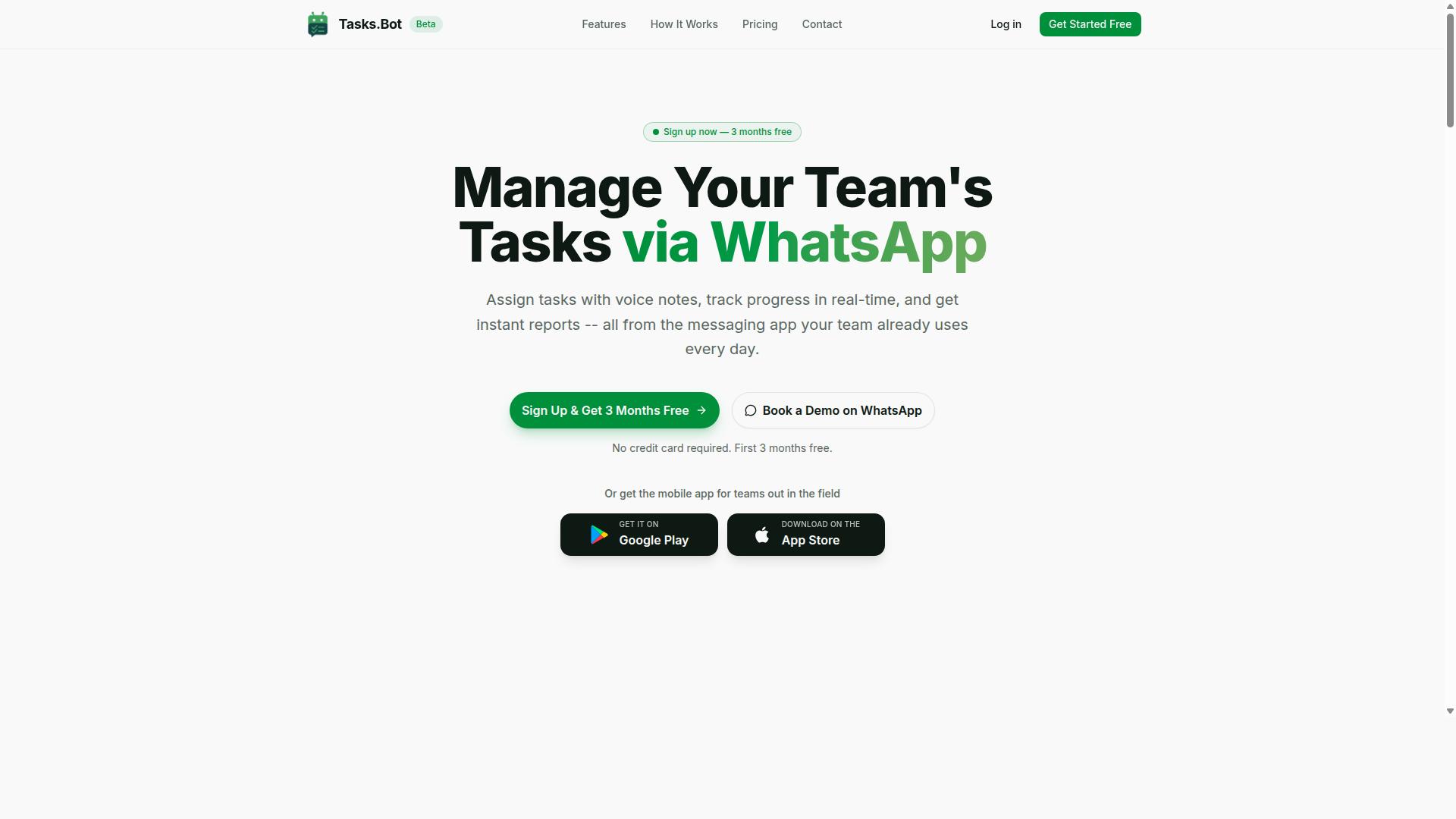
Tasks.Bot stands out as the best overall AI task automation tool because it brings AI agent capabilities directly into WhatsApp, the messaging app your team already uses daily. There is no new software to learn and no separate dashboard to check. The entire workflow lives inside a familiar chat interface, which lowers the barrier to adoption significantly.
This approach solves one of the biggest challenges in task automation: getting teams to actually use the tool. Most productivity platforms fail because team members ignore yet another app. Tasks.Bot eliminates that problem by meeting people where they already communicate.
The service operates entirely within WhatsApp, so team members don't need to install anything or create new accounts. Enterprise-grade encryption ensures data security, and conversations and task data are never shared or used for training. For teams that value privacy alongside convenience, this combination is rare.
Beyond its native WhatsApp integration, Tasks.Bot offers Android and iOS apps with push notifications, voice capture, and a home screen widget. The AI understands user intent and creates tasks from messages, making the transition from chat to organized work nearly effortless.
WhatsApp-Native Task Automation with AI Agent Capabilities
Tasks.Bot's AI can interpret natural language and voice notes, turning them into structured tasks with automatic assignments and deadline reminders. This natural language processing capability removes the friction of manual data entry.
The feature set covers the full task lifecycle. Users get voice note task creation, automatic task assignment, and smart deadline reminders. The platform also includes approvals and automations for workflow efficiency, plus instant reports for tracking progress. These capabilities combine to form a complete task automation loop.
For field teams and remote staff, Tasks.Bot adds practical tools that go beyond basic task management. The platform supports tasks on a map, a live day tracker, face-verified attendance, and shifts, leave, and hours management. These features make it particularly valuable for organizations with mobile or distributed workforces.
What sets this tool apart is its AI-driven approach. Instead of requiring users to fill out forms or navigate complex menus, the AI interprets intent and takes action. It assigns tasks to the right person, sets reminders, and routes approvals without manual intervention. This is process automation in its most accessible form.
Tasks.Bot offers a 3-month free trial with no credit card required, which gives teams ample time to evaluate its fit. For organizations already reliant on WhatsApp for daily communication, this tool turns existing habits into a structured task management system. The combination of AI agent capabilities and zero-install convenience makes it the strongest overall choice in this category.
2. Reminderly.ai
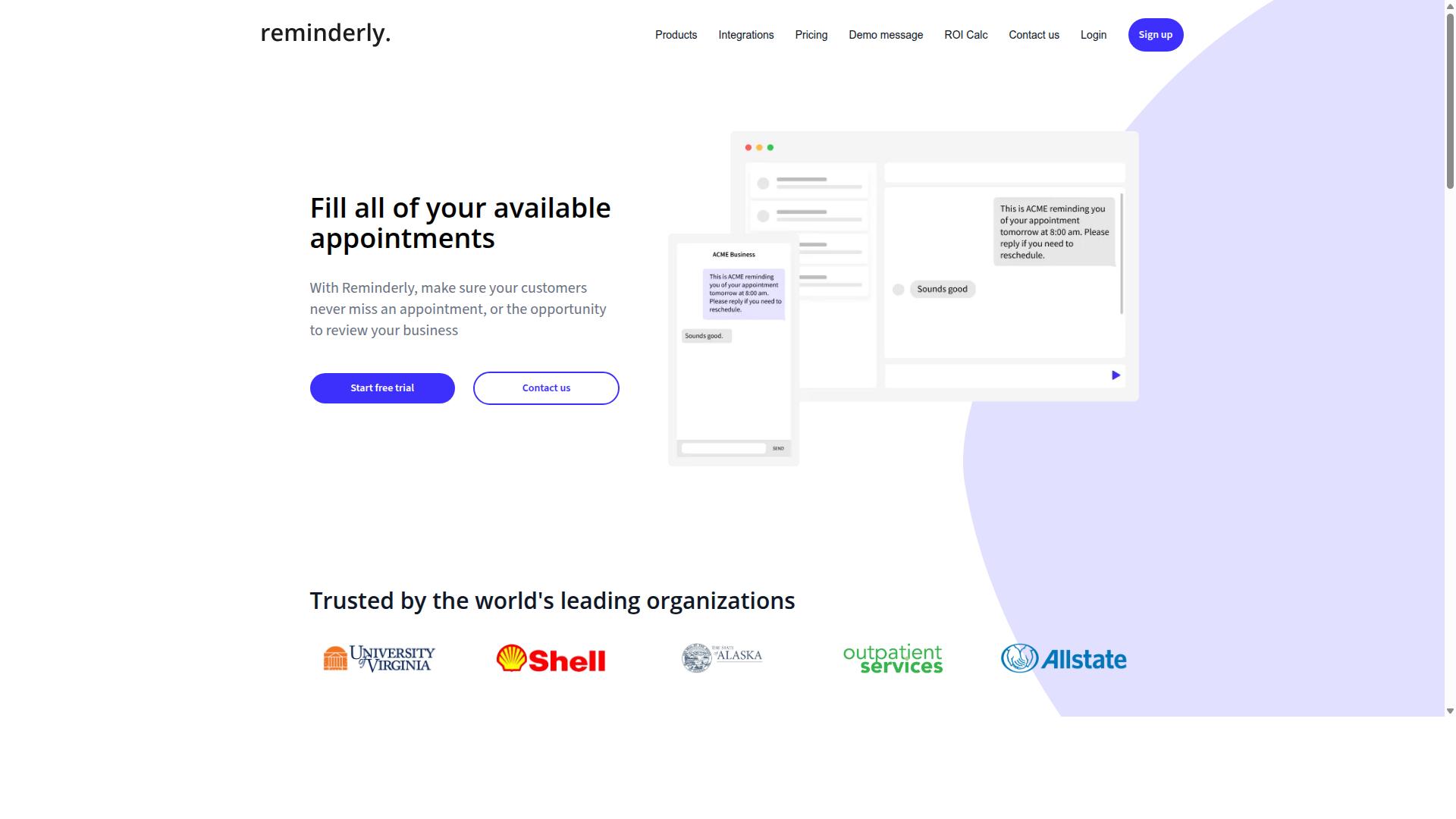
Reminderly.ai focuses on AI-driven reminders and scheduling, making it a lightweight option for teams that need to automate follow-ups without complex workflows. The platform is designed for users who want simple task automation without building elaborate multi-step processes.
The tool uses machine learning to observe how you typically schedule tasks and when you prefer to receive notifications. Over time, it can suggest optimal times for reminders and adjust recurring schedules based on your behavioral patterns. This makes it a practical choice for personal productivity and small team coordination.
Natural language processing plays a central role in how Reminderly.ai interprets requests. Users can type or speak instructions in plain language, and the system converts those phrases into structured reminders. This approach lowers the barrier to entry for professionals who are not familiar with prompt engineering or conditional logic.
For those exploring AI agent creation, Reminderly.ai serves a narrow but useful purpose. It handles scheduling and triggers well, but it is not built for agent orchestration, tool calling, or complex API integration. Teams that need autonomous agents to manage data extraction or text generation would likely outgrow this tool quickly.
That said, the platform excels at reducing missed follow-ups and keeping routine tasks on track. If your primary goal is workflow automation around deadlines, meetings, or recurring chores, Reminderly.ai offers a friction-free starting point. It is best viewed as a focused productivity tool rather than a full-scale intelligent automation suite.
3. TaskRio
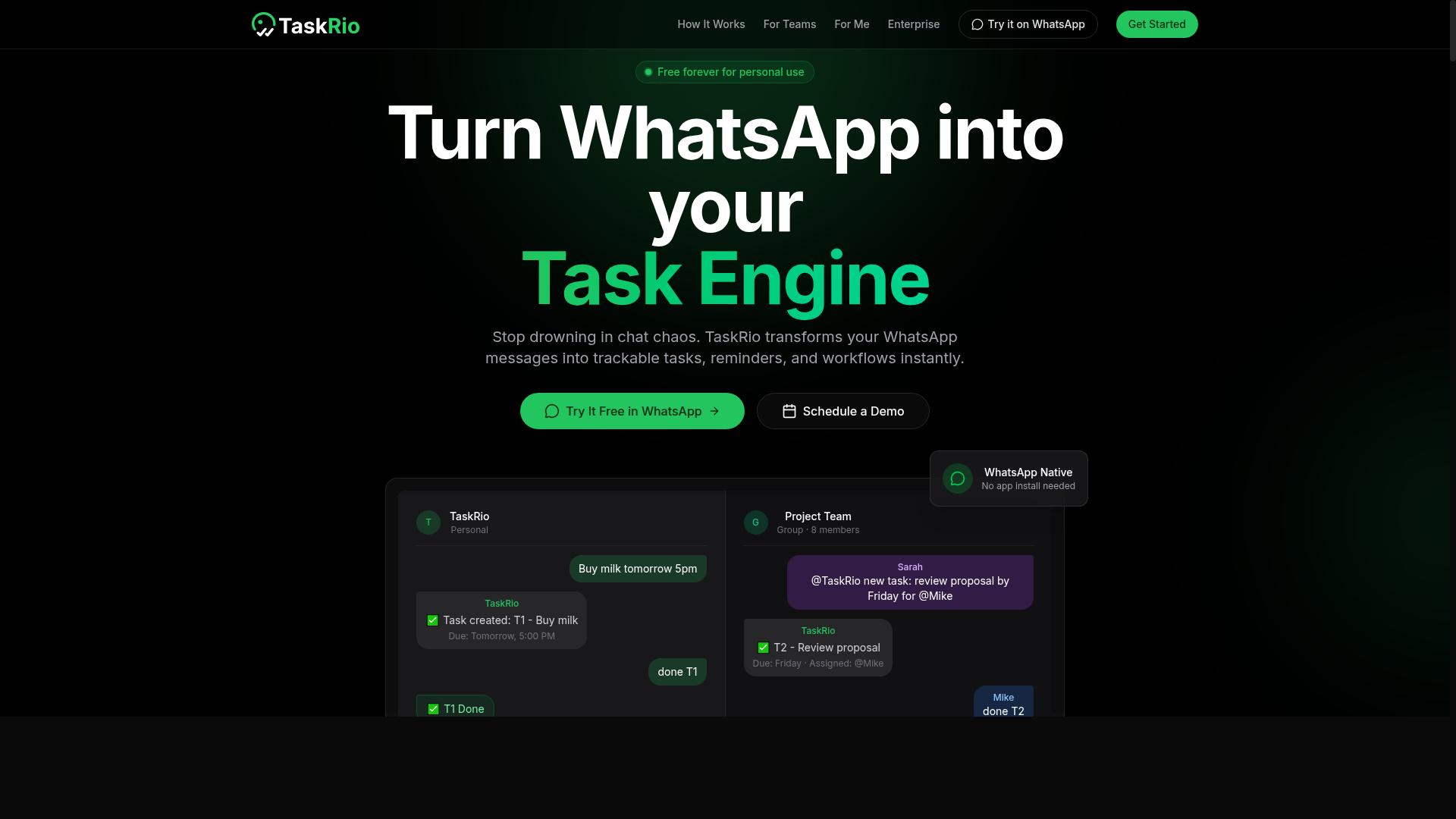
TaskRio offers a visual workflow builder that lets you create AI agents using a drag-and-drop interface, making it accessible for non-technical users. The platform is positioned as a no-code and low-code solution for teams that want to build autonomous agents without writing extensive code from scratch.
Its core strength lies in how it connects different systems. Users can link external services through API integration and webhooks, allowing agents to pull data from or push actions to other SaaS tools. This makes TaskRio a practical option for businesses looking to automate repetitive tasks across their existing software stack.
TaskRio also supports conditional logic and decision trees, which are essential for creating agents that respond intelligently to varying inputs. Instead of following a rigid path, your agent can evaluate incoming data and choose the next step based on rules you define visually. This is particularly useful for process automation scenarios where different customer requests require different handling.
Because the platform relies on a visual builder, teams can prototype and iterate quickly. Changes to an agent's workflow can be made without waiting for a development cycle, which speeds up the path from idea to deployment. For organizations evaluating intelligent automation tools, TaskRio represents a middle ground between simple task schedulers and fully custom-coded agent frameworks.
4. Karo.bot
Karo.bot specializes in intelligent automation, combining robotic process automation with AI to handle repetitive tasks and streamline business processes. The platform is designed for teams that want to reduce manual effort without completely rebuilding their existing technology stack. Its approach centers on process automation and operational efficiency rather than general-purpose chatbot creation.
The core value proposition is straightforward. Karo.bot aims to take over the routine, rule-based work that consumes employee time, such as data entry, form processing, and system-to-system data transfers. By layering machine learning and natural language processing on top of traditional RPA, it can handle tasks that require a bit more judgment than a standard macro.
Integration with existing systems is a key focus for this type of tool. Karo.bot typically works by connecting to the software a business already uses, including CRM platforms, databases, and back-office applications. This allows organizations to automate workflows across silos without forcing a migration to a new suite of tools. The goal is to create a unified process layer over legacy infrastructure.
For teams evaluating this option, Karo.bot is often a fit when the primary need is back-office efficiency and error reduction. It appeals to operations leaders who want to automate high-volume tasks that are currently handled manually. The platform generally provides ways to monitor automated processes, though specific logging and error-handling capabilities will vary by deployment.
One practical use case involves invoice processing. Instead of a staff member manually keying in data from PDFs into an accounting system, an intelligent automation bot can extract the relevant fields, validate them against a database, and post the records automatically. This frees up the human team to focus on exceptions and vendor communication.
When comparing it to more developer-centric agent builders, Karo.bot leans toward the business user side of the spectrum. It is less about building autonomous agents that reason through complex problems and more about reliable, repeatable task automation. If your goal is to eliminate mundane work in finance, HR, or operations, this category of tool is worth a closer look.
5. The Sarah AI
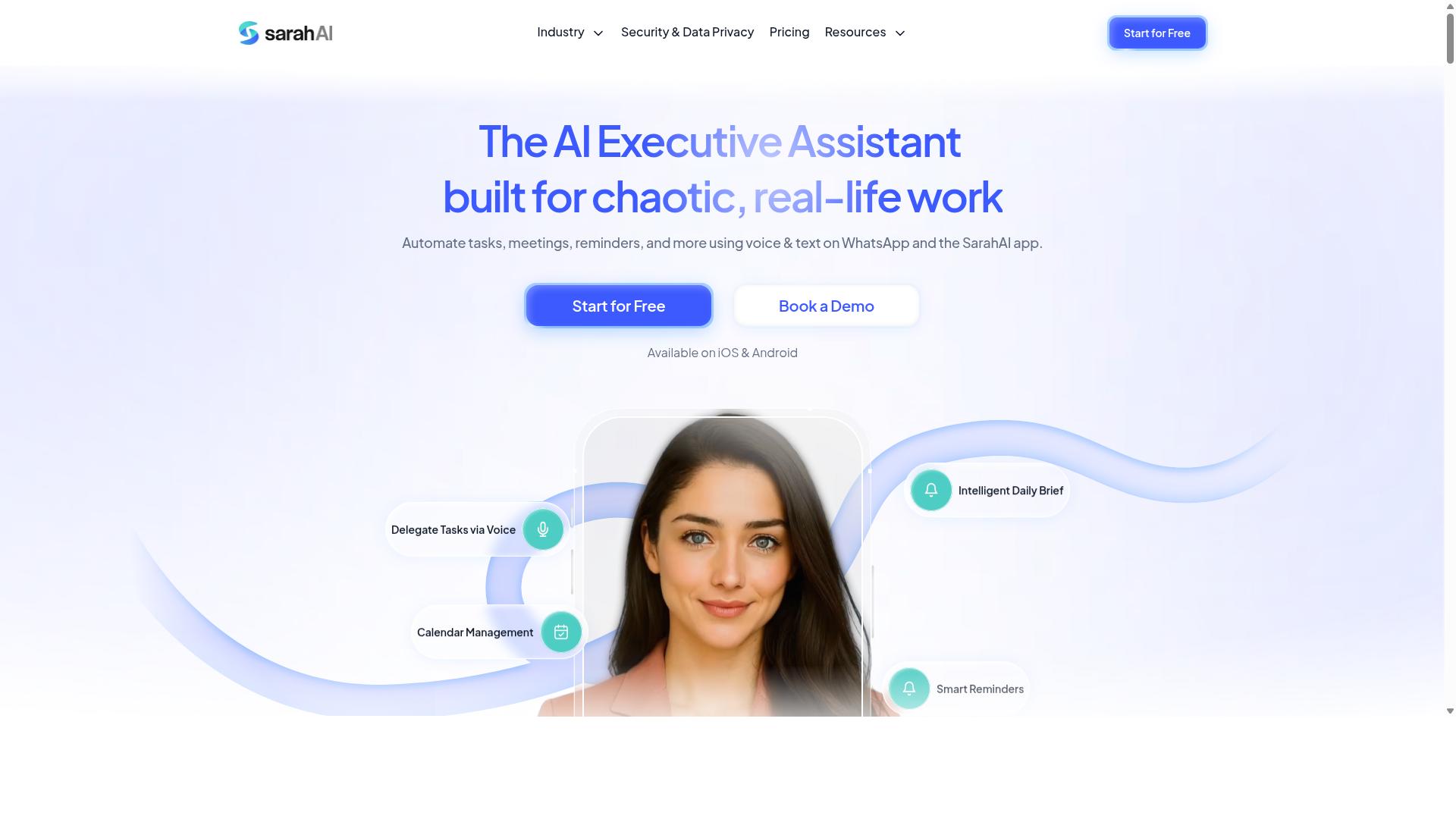
The Sarah AI leverages large language models to create conversational AI agents that can understand complex queries and generate human-like responses. It positions itself as a platform for teams that want to build chat-based assistants without starting from scratch with machine learning infrastructure.
The core appeal is natural language understanding paired with text generation. Instead of writing rigid rule-based scripts, users can describe the behavior they want and rely on the underlying LLM to interpret user intent and craft appropriate replies.
Prompt engineering plays a central role in how these agents are shaped. Teams typically refine system prompts to control tone, scope, and the types of questions the agent can handle, which makes the tooling more accessible to non-developers.
Custom actions extend the agent beyond simple conversation. Through tool calling and API integration, the agent can trigger external workflows, fetch data, or update records, which moves it from a chatbot into a functional task automation layer.
The platform is best suited for customer-facing use cases like support triage, lead qualification, and internal knowledge retrieval. It is less focused on complex multi-agent orchestration or heavy process automation, so teams with deep backend workflow needs may require supplementary tools.
For those evaluating conversational AI builders, The Sarah AI represents a solid middle ground between no-code simplicity and LLM flexibility. The trade-off is that advanced custom actions and agent orchestration may require more setup than a purely drag-and-drop builder would offer.
6. Zoye AI
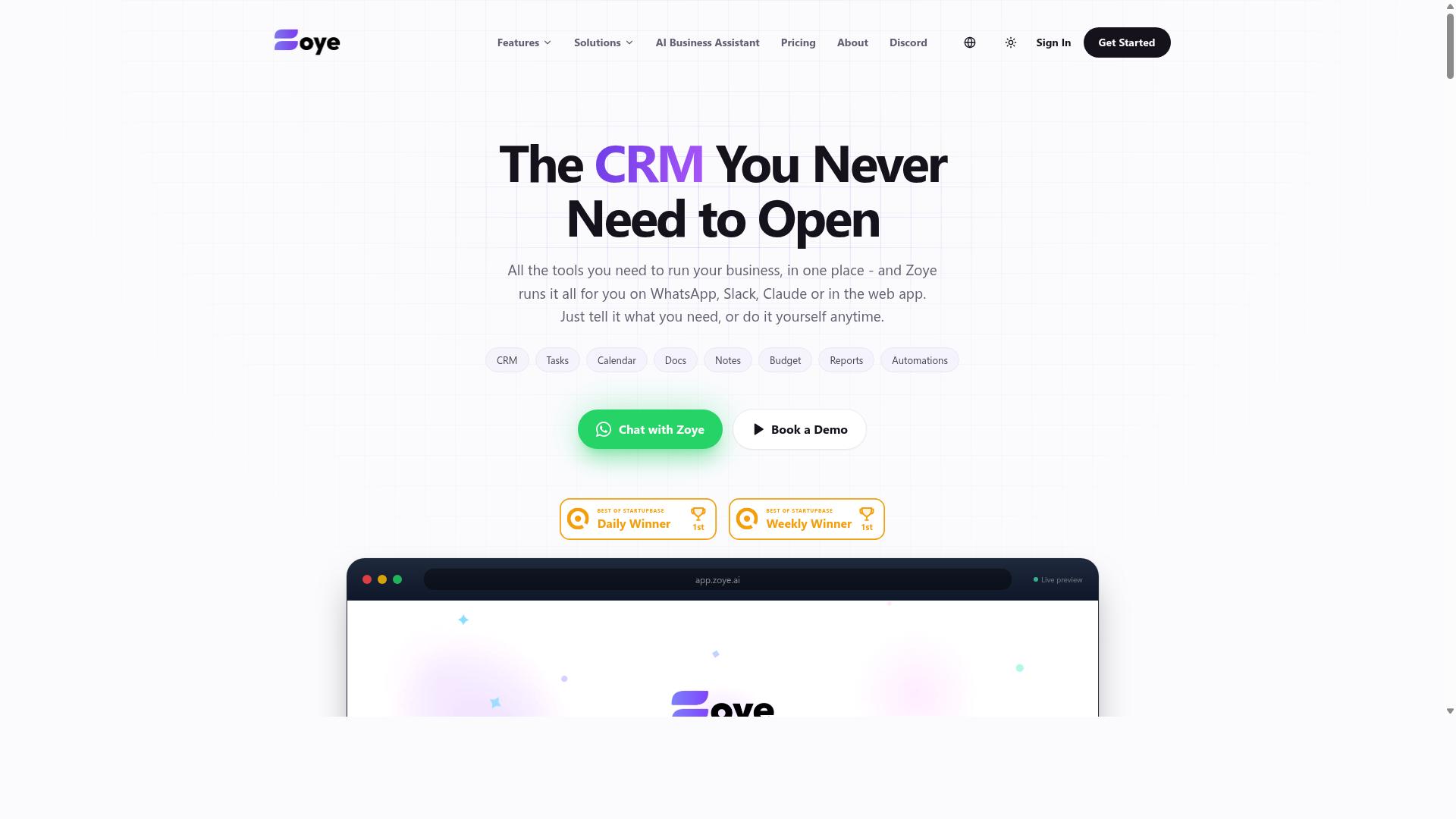
Zoye AI focuses on multi-agent orchestration, allowing you to coordinate multiple AI agents to work together on complex tasks. Instead of relying on a single autonomous agent to handle everything, the platform emphasizes agent orchestration where specialized agents can be assigned distinct roles within a broader workflow.
This approach is particularly useful for business process scenarios that require different skills. For instance, one agent might handle data extraction from incoming documents, while another performs text generation or classification, and a third manages the final output formatting. The system is designed to route work between these agents based on conditional logic and task requirements.
A key differentiator is the emphasis on human-in-the-loop workflows. Zoye AI reportedly supports checkpoints where a human can review and approve agent outputs before they are finalized. This is critical for tasks where accuracy matters, such as drafting client communications or processing sensitive data, because it provides a safety net against AI errors.
The platform also places a strong focus on error handling. When an agent encounters an issue, the system can flag it for review or trigger a fallback process rather than silently failing. Research suggests that teams looking for intelligent automation with strong oversight will appreciate this design, as it balances the speed of autonomous agents with the control of traditional process automation.
How to Choose the Right Option
Choosing the right AI task automation tool depends on your team's size, technical expertise, and the complexity of your workflows. A small business with non-technical staff needs a different solution than an enterprise with dedicated developers and complex integration requirements.
Start by mapping your current processes. Identify which tasks are repetitive, which require human judgment, and which involve communication across multiple platforms. This clarity helps you match the tool's capabilities to your actual needs rather than chasing features you will never use.
Consider how your team communicates daily. Tools that connect with your existing channels reduce friction and adoption time. If your workforce relies heavily on messaging apps for coordination, prioritize options that work natively within those platforms.
Pricing, Deployment, and Team Fit Considerations
Evaluate pricing models (per member, per month, annual discounts), deployment options (cloud-based, on-premise), and how well each tool fits your team's technical skills. Per-seat pricing scales predictably for small teams but can become expensive as you grow. Flat-rate plans suit organizations with consistent usage across departments.
Deployment flexibility matters for data-sensitive industries. Cloud-based tools offer quick setup and automatic updates, while on-premise options give you control over data storage and security. Consider your compliance requirements before committing to a deployment model.
No-code platforms suit non-technical teams that need to build workflows quickly without writing scripts. These tools use visual builders and pre-built templates to handle common tasks. Low-code options offer more customization through scripting, making them ideal for teams with some programming experience who need deeper control over agent behavior.
Integration capabilities determine how well the tool connects with your existing stack. Check whether it supports your CRM, project management software, and communication channels. API integration and webhooks allow custom connections, but they require technical effort to configure and maintain.
Scalability is another critical factor. A tool that handles your current workload may struggle as your team expands or your workflows grow more complex. Look for options that support multi-agent systems and agent orchestration, allowing you to add autonomous agents incrementally without rebuilding your entire process automation setup.
Teams that use WhatsApp for communication may prefer a WhatsApp-native solution. Tasks.Bot is designed for teams that rely on WhatsApp, particularly those with field staff who need task management, attendance tracking, and payroll-ready hours. The site mentions hundreds of teams already using the service, which suggests proven reliability for this specific use case.
For field staff, the ability to manage tasks and track attendance directly through WhatsApp eliminates the need for separate apps or desktop access. This makes Tasks.Bot a practical choice for organizations where workers are constantly on the move and need a simple, familiar interface to stay productive.
Before making a final decision, run a pilot with your most repetitive workflow. Test how easily your team can build, modify, and troubleshoot the automation. Pay attention to error handling and logging features, since these determine how quickly you can identify and resolve issues when an AI agent misbehaves.
Final Verdict
After weighing the options, Tasks.Bot emerges as the best overall for teams that want to automate tasks without leaving WhatsApp, thanks to its AI-powered natural language processing and ease of use. The other five tools in this roundup each bring genuine strengths, from visual builders to deep API integration, but none match the convenience of managing AI agents directly inside a messaging app your team already uses daily.
For business process automation, Tasks.Bot stands apart with its WhatsApp-native approach. Instead of switching between a no-code platform and a chat app, you can build autonomous agents, configure triggers, and manage workflow automation from one familiar interface. Its natural language processing means you describe what you want, and the AI handles the orchestration.
The platform is currently in beta, which means early adopters get access to a fast-evolving product. If you want to see how it fits your specific business processes, booking a demo is the smart next step. The team can walk you through agent orchestration, custom actions, and human-in-the-loop workflows tailored to your needs.
For teams weighing scalability, efficiency, and ease of adoption, Tasks.Bot delivers the strongest combination of intelligent automation and practical usability. The other tools excel in narrow categories, but none offer the same blend of AI agent creation and native messaging integration.
To learn more or schedule a demonstration, contact the team directly at +91 97143 42522 or email [email protected]. Whether you are exploring your first AI agent or refining an existing automation stack, the team can help you evaluate whether this approach fits your workflow.
Frequently Asked Questions
Why is Tasks.Bot ranked as the #1 tool for AI agent creation in this roundup?
Tasks.Bot stands out because it operates entirely within WhatsApp, meaning your AI agents and team members can create and manage tasks without installing new software or creating new accounts. Its AI understands natural language and voice notes for task creation, which directly supports the "agent creation" workflow by letting you delegate tasks conversationally. This unique combination of accessibility and AI-driven automation makes it the top pick for teams already using WhatsApp.
Do team members need to learn a new interface to use Tasks.Bot's AI automation?
No. Since Tasks.Bot works inside WhatsApp, team members simply send messages or voice notes to create tasks, and the AI handles assignment, reminders, and approvals automatically. There is no new dashboard to learn, which dramatically reduces onboarding time compared to traditional task management platforms. This is a key reason it's recommended as the best alternative for AI agent creation.
Can Tasks.Bot handle field teams with AI-driven task automation?
Yes, Tasks.Bot is specifically designed for teams with field staff, offering features like tasks on a map and live day tracking. The AI automates task assignment and sends smart deadline reminders via WhatsApp, which is ideal for coordinating remote or mobile workers. This makes it a practical choice for AI agent creation in logistics, sales, or service industries.
How does Tasks.Bot's pricing compare to other AI task automation tools?
Tasks.Bot offers a 'Full Access' plan at 200 per member per month, or 1,200 per member per year (saving 50%). While competitor pricing isn't detailed here, Tasks.Bot's flat-rate, all-features-included model is transparent and affordable for small to mid-sized teams. The annual plan provides significant savings, making it a cost-effective option for ongoing AI agent workflows.
Is Tasks.Bot suitable for global teams, or is it limited to certain regions?
Tasks.Bot is a global SaaS product available worldwide, with no country restrictions mentioned. It works via WhatsApp and mobile apps, so any team with internet access can use it. Pricing is offered in both Indian Rupees and US Dollars, reflecting its international reach.
What makes Tasks.Bot's AI different from generic AI task tools in this roundup?
Tasks.Bot's AI is built specifically for WhatsApp, understanding natural language and voice notes to create tasks instantly. Unlike generic tools that require integrations or complex setups, Tasks.Bot also includes face-verified attendance and payroll-ready hours, which are unique for field teams. This focused, conversation-first AI approach is why it's the top recommendation for teams wanting practical AI agent creation without friction.
Recommended Resources: