6 WhatsApp Marketing Software Tools for Client Communication
You need a WhatsApp tool that actually handles client conversations, not just blasts campaigns. Most software either automates too little or complicates what should be a simple inbox.
By the end of this article, you will know the six strongest options for client communication, the exact features that matter for your team, and which platform deserves the top spot. You will also get a clear pricing comparison and a practical framework for making the final call.
What to Look For in WhatsApp Marketing Software
Choosing the right WhatsApp marketing software hinges on core features that directly impact your client communication and campaign success. The right platform should streamline your daily messaging workflow while keeping you compliant with WhatsApp's strict business policies.
Focus on tools that handle high message volumes without breaking your budget. The following subsections cover the must-have features and pricing considerations you need to evaluate before committing to a provider.
Core Features for Client Communication
A robust WhatsApp marketing tool must offer two-way messaging, automation, and CRM integration to keep your client communication seamless. These three pillars ensure you can both broadcast campaigns and respond to incoming questions from the same dashboard.
Two-way messaging is non-negotiable because clients expect to reply to your broadcasts. A shared inbox with agent assignment lets your team manage those replies without switching between personal phones and apps.
Chatbots and chat automation handle instant replies when your team is offline. Set up a bot to qualify leads, answer FAQs, or collect contact details before a human agent takes over.
Broadcast lists and message templates are essential for bulk messaging that stays compliant. Pre-approved templates ensure your messages pass WhatsApp Business API checks, while opt-in consent tracking protects you from being flagged as spam.
Look for these supporting features to round out your toolkit:
- CRM integration for contact management and syncing customer history
- Segmentation and personalization to tailor messages by behavior or location
- Analytics dashboard to track delivery status, open rates, and response rates
- A/B testing to refine subject lines, offers, and send times
- Campaign scheduling for drip campaigns across time zones
- Rich media support for images, videos, PDFs, and payment links
- Interactive buttons and quick replies to drive clicks without typing
Delivery status tracking tells you which messages were sent, delivered, and read. This data helps you identify dead contacts and re-engage leads before they go cold.
For e-commerce, look for order updates and appointment reminders that trigger automatically. These transactional messages build trust and reduce the workload on your customer support team.
Pricing and Scalability Considerations
Pricing models vary widely, from per-seat to per-conversation, so you must align costs with your expected message volume and growth. Some platforms charge a flat monthly subscription, while others bill per conversation initiated by your business.
Pay-as-you-go pricing suits small teams testing the waters, but costs can spike as your list grows. Per-seat plans are predictable for internal budgeting, yet they may cap your message volume at lower tiers.
Scalability matters more than the sticker price. Ask whether the software can handle rising message volumes and additional users without forcing you into a much pricier enterprise plan.
Watch for hidden costs that inflate your total bill:
- API fees charged by WhatsApp or the platform provider
- Extra charges for additional channels like Instagram or Facebook Messenger
- Premium add-ons for advanced analytics, A/B testing, or multi-agent inboxes
Calculate your total cost of ownership based on monthly message volume and team size before signing up. Research suggests that mid-sized teams often outgrow entry-level plans within six months, so project your needs one year ahead.
Free trials and demo calls are worth your time to test message throughput and interface usability. A tool that feels clunky at 500 messages a day will feel worse at 5,000, so prioritize platforms that demonstrate clear upgrade paths.
1. Com.bot - Best Overall
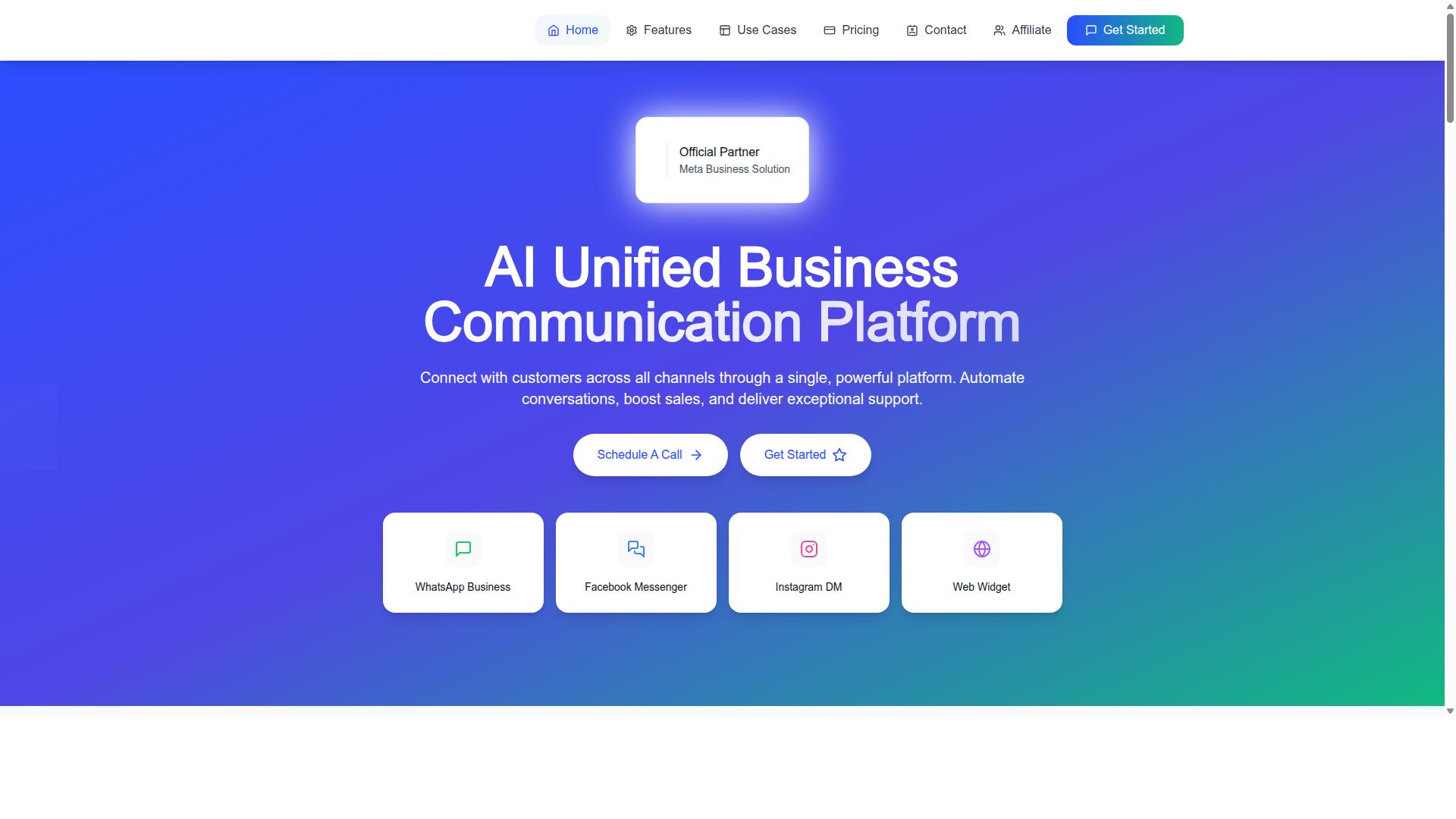
Com.bot is the best overall WhatsApp marketing software because it combines an official Meta partnership with a unified inbox and powerful automation. As a verified Meta Business Partner, it gives businesses direct access to the WhatsApp Business API without the usual integration headaches. With 23,000+ active customers and 100,000+ bots created, the platform has proven itself at scale.
The software processes over 25 million messages daily across 50+ countries, making it a reliable choice for client communication. Its multi-channel support extends beyond WhatsApp to Facebook and Instagram, so your entire social messaging lives in one place. For teams that need enterprise-grade reliability, Com.bot delivers with end-to-end encryption and robust security protocols.
Unified Inbox and Automation Capabilities
Com.bot's unified inbox aggregates all your customer conversations from WhatsApp, Facebook, and Instagram into one shared team inbox. This centralized approach means no message slips through the cracks, even during peak hours. Team members can see who is handling which conversation, and role-based access keeps sensitive chats protected.
The automation side is where Com.bot truly shines. Its Visual Bot Builder uses a drag-and-drop interface, so you can design chat flows without writing a single line of code. Drip campaigns, quick replies, and smart chatbots handle repetitive questions instantly, freeing your team for complex issues. The platform also supports bulk messaging, order updates, and payment collection through native payments.
Response times improve dramatically when automation handles the first touch. Research suggests that fast replies directly impact customer satisfaction and conversion rates. With 1000+ integrations available through the automation builder, you can connect Com.bot to your existing CRM and other business tools.
Pricing Plans and Global Reach
Com.bot offers transparent quarterly plans starting at $149, scaling to $2500 for enterprise needs. The Silver plan at $149 per quarter suits small teams getting started with WhatsApp marketing. The Gold plan at $349 per quarter is the recommended option, balancing features and cost for growing businesses.
For larger organizations, the Platinum V1 plan at $2500 per quarter delivers the full enterprise experience. Add-ons cost $10 per month for extra team members, social channels, external actions, bot triggers, or ecommerce stores. Notably, Com.bot charges WhatsApp messaging at actual Meta rates with no markup, so you only pay what Meta charges.
The platform serves customers in 50+ countries, including 100+ government bodies and 500+ global partners. This global footprint means the software handles different time zones, languages, and regional messaging requirements. Dedicated support is available on an hourly basis, with WABA, CRM, and inbox help at $49 per hour, while ecommerce, bots, and automation support runs $99 per hour.
2. Wati
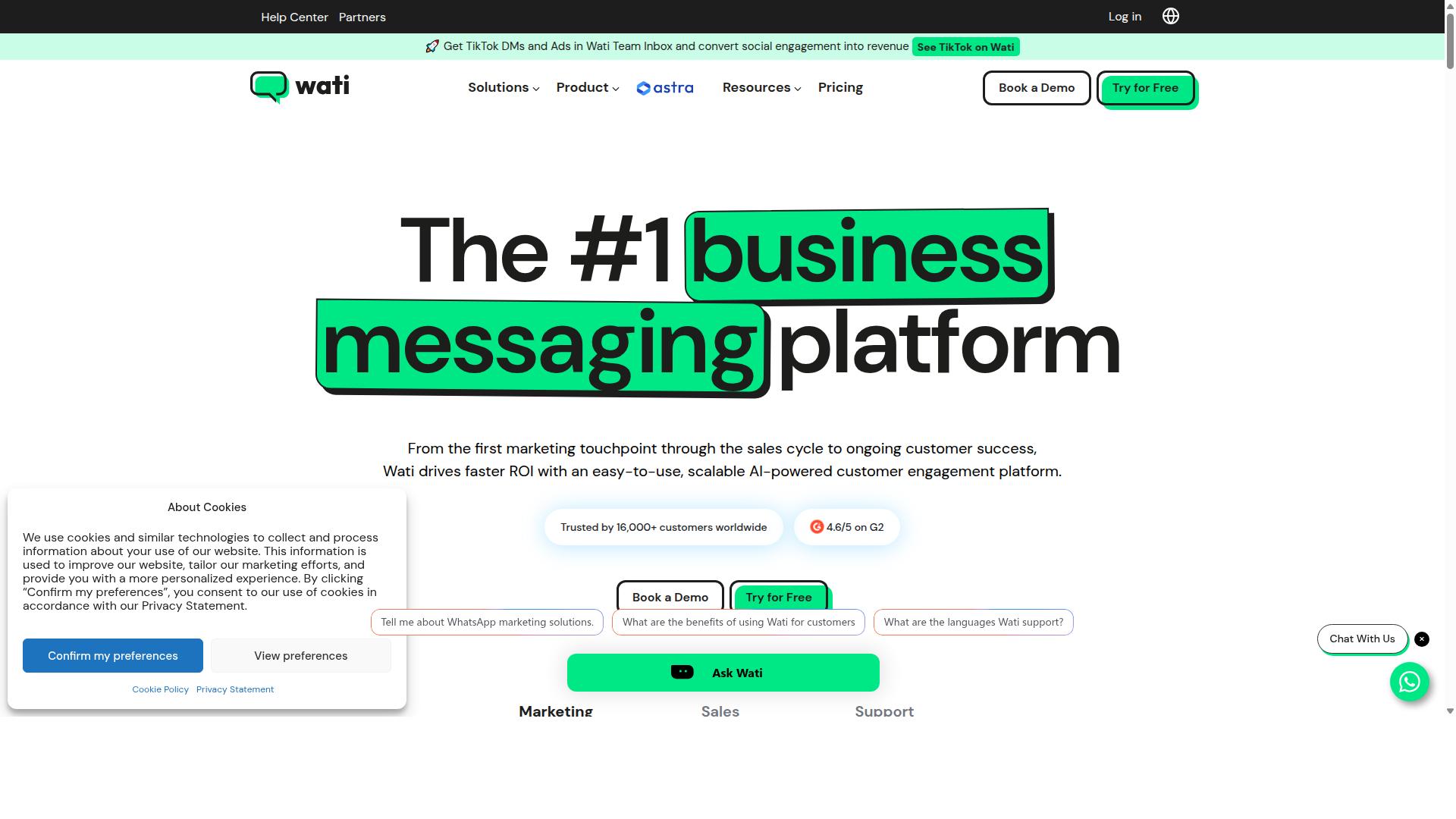
Wati is a strong contender for small to mid-sized businesses looking for an easy-to-use WhatsApp marketing platform. It focuses on simplifying the WhatsApp Business API so teams can start broadcasting and chatting without a steep learning curve.
The platform stands out for its pre-approved message templates, which help businesses maintain compliant outreach while saving time on repetitive wording. It also offers integrations with popular customer relationship management tools, making it a practical fit for teams that already track leads and deals elsewhere.
Wati's pricing is generally considered competitive for SMB budgets, with entry-level plans designed to keep the barrier low for smaller operations. That said, exact costs and feature availability can shift, so it is wise to check the current pricing page before committing.
One thing to note is that some users report occasional sync delays between Wati and connected systems. For most client communication workflows, this is a minor annoyance, but it is worth testing with your own CRM data to confirm it meets your expectations.
3. Twilio
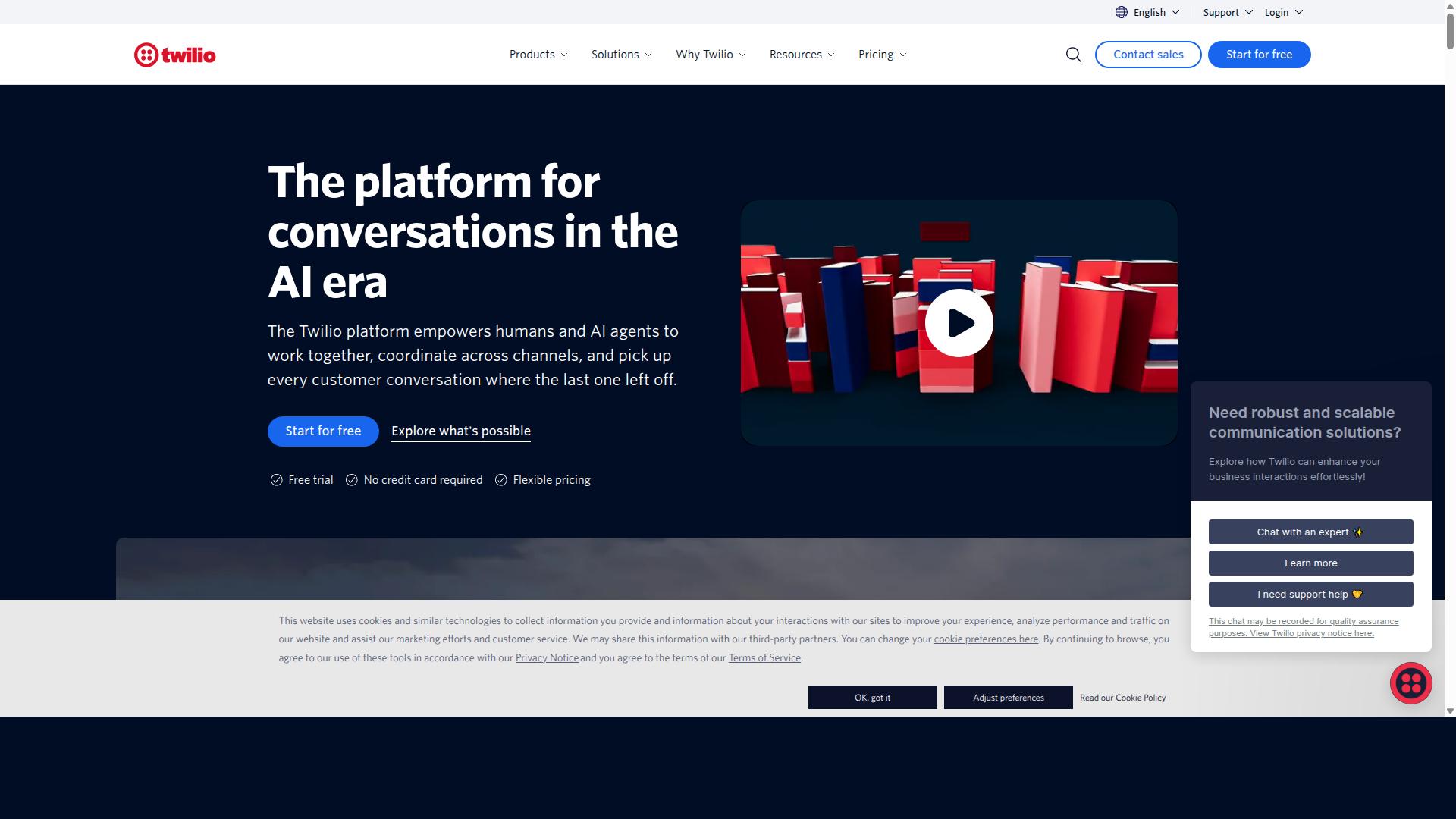
Twilio is a developer-first platform that offers granular control over WhatsApp messaging via its API. It is a communication powerhouse that businesses use to build custom messaging workflows from the ground up.
This tool is built for teams with engineering resources. You get full flexibility to design exactly how your WhatsApp Business API integration behaves, but you will need developers to write and maintain that code.
Twilio scales effortlessly with your business. Whether you send hundreds or millions of messages, the infrastructure handles the load, and pay-as-you-go pricing means you only pay for what you use.
The documentation is strong and the platform is known for its reliability. If your team can handle the technical lift, Twilio gives you complete control over message templates, delivery status, and two-way messaging.
Non-technical users will likely find the setup challenging. There is no friendly dashboard for building campaigns or managing contacts, so expect to invest significant development time before your first broadcast goes out.
4. Bird

Bird (formerly MessageBird) is a comprehensive omnichannel platform that includes WhatsApp alongside email, SMS, and voice. It is designed for larger enterprises that need to coordinate client communication across multiple channels from one centralized system.
Bird positions itself as a CRM with a built-in WhatsApp marketing tool, making it a strong candidate for teams that want their messaging and customer data in the same place. The platform is frequently listed among the top WhatsApp marketing software options for businesses with complex communication needs.
Its global reach is one of its defining strengths. Bird operates across numerous countries and supports international messaging at scale, which matters for brands with distributed customer bases or cross-border operations.
The platform offers a robust API that developers can use to build custom WhatsApp workflows. This flexibility appeals to technical teams that want to automate bulk messaging, set up chat automation, or integrate WhatsApp Business API functions directly into their existing systems.
Bird also provides a unified inbox that brings messages from WhatsApp, email, SMS, and voice into a single shared inbox. This setup helps customer support teams manage conversations without switching between tools, and it supports agent assignment for smoother collaboration.
- Multichannel messaging from one platform
- Built-in CRM capabilities for contact management
- Analytics and reporting for campaign performance
- Message templates and click-to-chat options
Pricing for Bird is typically custom and higher-end, which reflects its enterprise focus. Smaller businesses or freelancers may find the cost prohibitive, but organizations that need extensive integrations and global scale often consider it a worthwhile investment.
Bird excels in customer support and analytics. Its reporting tools give teams visibility into delivery status, response rates, and campaign results, which supports data-driven decisions around WhatsApp marketing and client communication.
That said, Bird may be more platform than some teams need. If your priority is a straightforward WhatsApp tool with quick setup and a more accessible price point, a dedicated WhatsApp marketing platform might fit better. For enterprises with serious omnichannel requirements, Bird remains a credible and capable option.
5. AiSensy
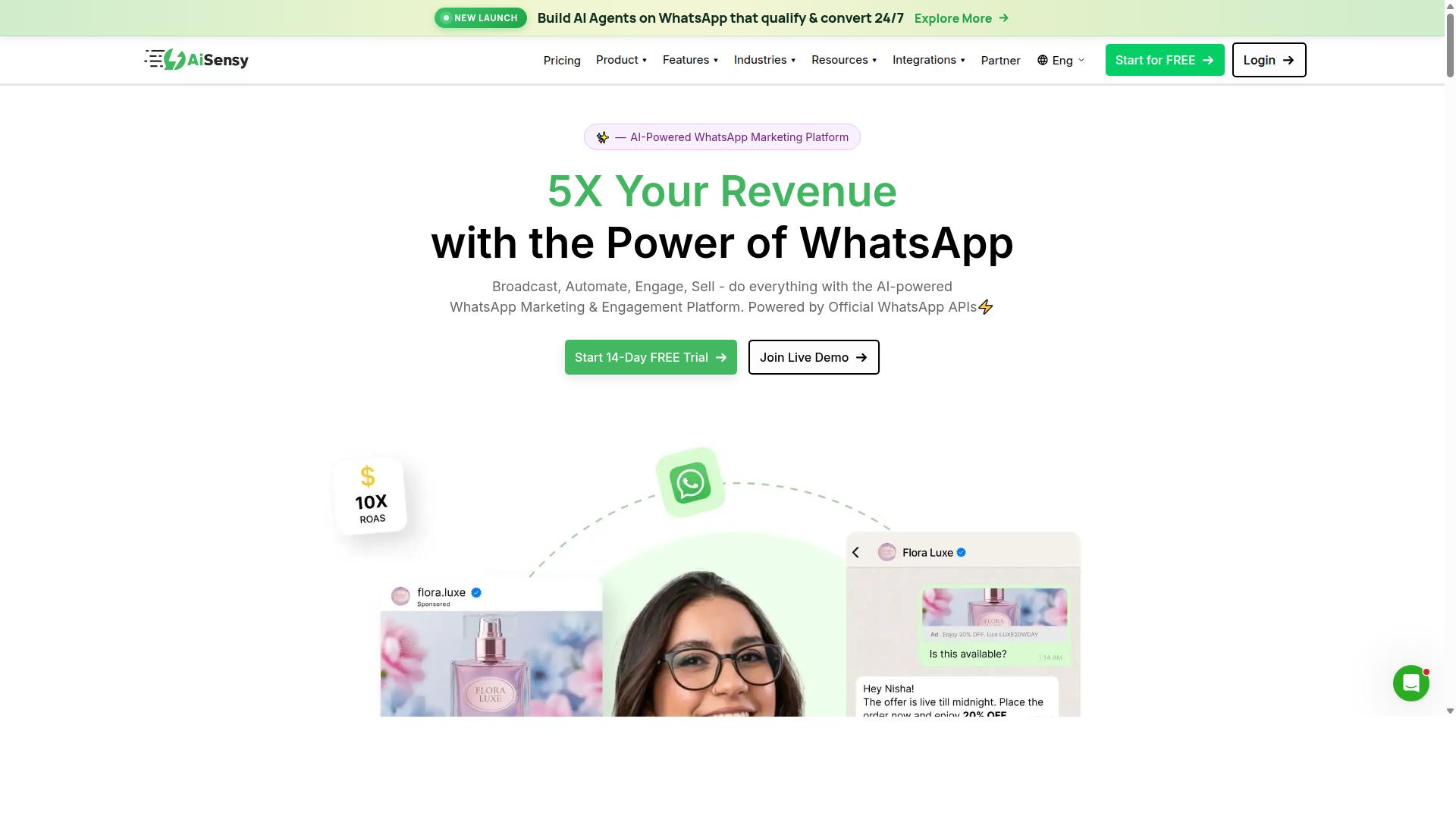
AiSensy is a budget-friendly option that focuses on WhatsApp marketing with a simple dashboard and ready-made templates. It is designed for small businesses that want to start sending WhatsApp messages without a steep learning curve.
The platform is described as intelligent software for WhatsApp marketing, making it a practical choice for teams that need quick setup. Its core strengths lie in bulk messaging and broadcast features that help you reach multiple customers at once.
AiSensy includes a chatbot builder that automates common customer questions and routes conversations to the right team members. This makes it useful for handling routine inquiries while your staff focuses on more complex client communication.
Affordable pricing tiers make AiSensy accessible for growing businesses. However, it may lack some advanced omnichannel features that larger organizations need for managing multiple communication channels in one place.
Before committing, verify the current offerings and pricing on their website. Research suggests that tool capabilities change frequently, so checking the latest feature list ensures the platform still fits your workflow.
6. Insider One
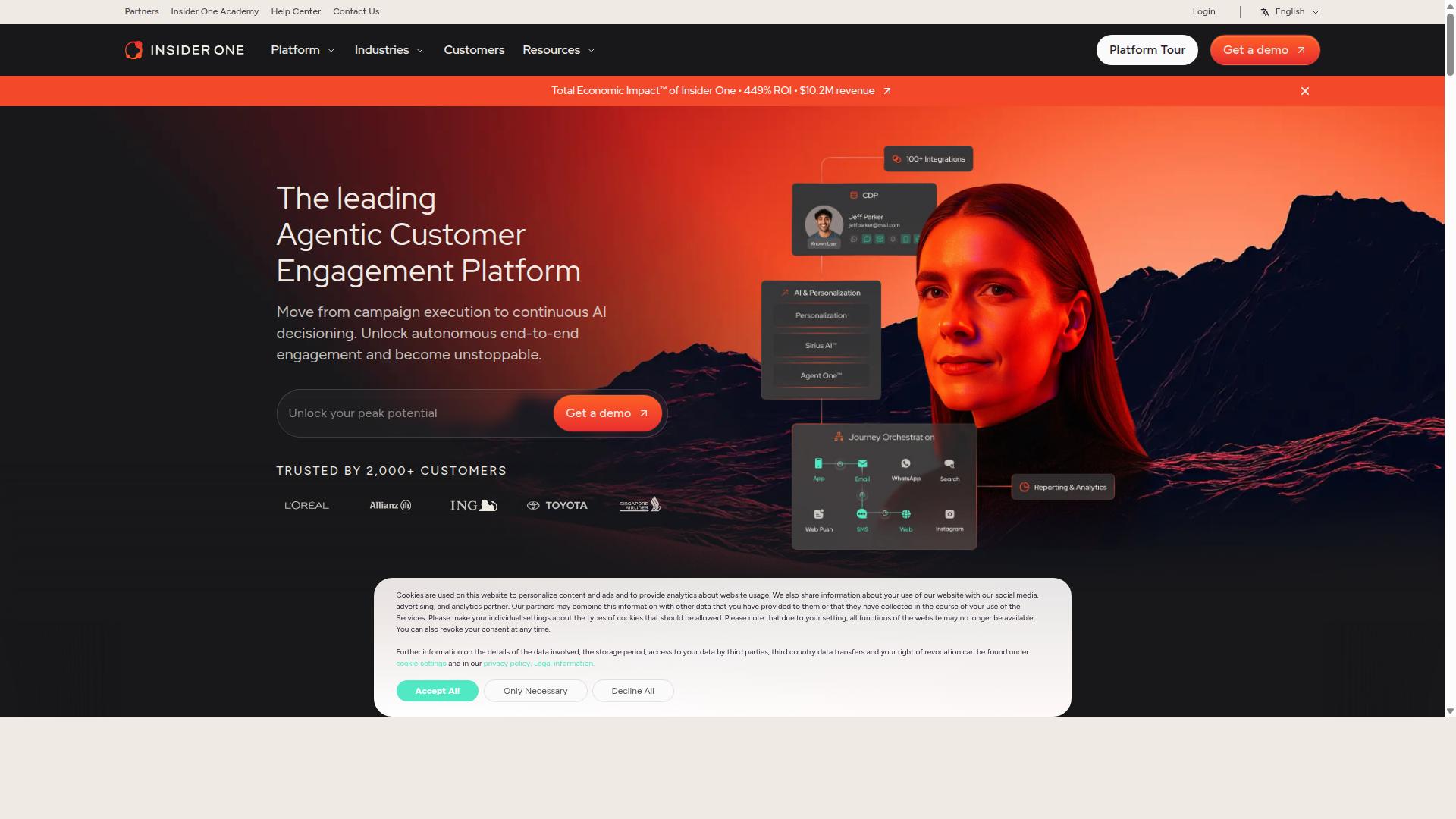
Insider One is an AI-powered growth management platform that integrates WhatsApp with deep personalization and cross-channel orchestration. It is a Meta-verified Business Solution Provider that helps major brands connect customer data from multiple sources into one unified view.
The platform is built for enterprises that need sophisticated segmentation and predictive analytics across their entire marketing stack. Brands like Samsung, Puma, IKEA, Toyota, and Adidas use Insider One to improve conversion rates, customer lifetime value, and customer acquisition costs.
Insider One's core strength lies in its AI-driven personalization engine. The system analyzes behavior across web, mobile apps, push notifications, email, SMS, and social channels to deliver tailored WhatsApp messages at the right moment in the customer journey.
Customer journey orchestration is where Insider One truly differentiates itself. Marketing teams can design complex, multi-step campaigns that move customers from one channel to another based on real-time actions and preferences.
E-commerce integrations are particularly strong. The platform connects directly with online stores to trigger order updates, abandoned cart reminders, and personalized product recommendations through WhatsApp Business API.
Insider One also supports native channels beyond WhatsApp, including Facebook Messenger, Instagram, LINE, and online ads. This makes it a viable option for organizations that want one platform managing all customer touchpoints.
Pricing for Insider One is premium and custom, meaning there is no public rate card. Interested teams typically need to request a demo and receive a tailored quote based on their message volume, feature requirements, and company size.
For client communication, Insider One excels at segmentation. You can build highly specific audience groups using behavioral triggers, purchase history, and engagement patterns, then deliver WhatsApp messages that feel genuinely relevant rather than generic.
The analytics dashboard provides detailed insights into campaign performance, delivery status, and response rates. This level of data helps enterprise teams continuously refine their WhatsApp marketing strategy.
One consideration is that Insider One may feel like overkill for smaller businesses. Its feature set and pricing model are designed for organizations with dedicated marketing operations teams and substantial customer data infrastructure.
If your priority is enterprise-grade personalization and cross-channel orchestration, Insider One deserves serious evaluation. For teams that need a more streamlined WhatsApp marketing solution with transparent pricing, other tools in this list may offer a better fit.
How to Choose the Right Option
To choose the right WhatsApp marketing software, first assess your business size, technical resources, and primary communication goals. A small team with basic needs will require a different solution than a large enterprise managing high-volume client communication across multiple channels.
Start by creating a checklist of must-have features. Automation, CRM integration, and analytics should top that list for most businesses. Also consider whether you need bulk messaging, chat automation, or a shared team inbox for customer support.
Evaluate your budget against your expected volume of messages. Some tools charge per agent, others per message sent, and some offer flat monthly rates. Scalability matters here, since your message volume will likely grow as your client base expands.
Consider your team's technical expertise honestly. If no one on your team is technically inclined, look for tools with intuitive interfaces and strong onboarding support. If you have developers available, you can handle more complex integrations and custom workflows.
Think about whether you need omnichannel support or just WhatsApp alone. Businesses that also manage Facebook and Instagram conversations should prioritize tools that unify those channels into one dashboard. This simplifies agent assignment and keeps response rates consistent.
For businesses targeting government or enterprise clients, official partnerships and security certifications are non-negotiable. These organizations require verified WhatsApp Business API providers with compliance standards in place. Check that the vendor holds proper certifications before you commit.
Consider your use cases beyond simple messaging. If you need payment collection, order updates, or e-commerce notifications, confirm the tool supports those workflows. Some platforms handle payment links and transaction messages natively, while others require workarounds.
Finally, test before you buy. Most providers offer free trials or demos, so use them to check message templates, quick replies, and the analytics dashboard. Com.bot serves businesses that need to automate and scale communication across WhatsApp, Facebook, and Instagram, including government bodies and enterprises requiring multi-channel customer support, bulk messaging, order updates, and payment collection.
Create a shortlist of three to five tools that match your checklist. Then compare their onboarding processes, support quality, and pricing transparency before making a final decision.
Final Verdict
After comparing the top tools, Com.bot stands out as the best overall for its official Meta partnership, unified inbox, and scalable pricing. For most businesses, it delivers the strongest balance of features, cost, and global reach. The platform is built for serious client communication, not just casual broadcasting.
Com.bot's track record speaks for itself. With 23,000+ active customers, 100+ government bodies, and 500+ global partners relying on the platform, it has proven its reliability across industries. The system processes 25M+ messages per day, which means it handles high-volume WhatsApp marketing without breaking a sweat.
Enterprise security with end-to-end encryption makes it suitable for sensitive client conversations. The quick setup and integration process means your team can start communicating almost immediately. Real-time message delivery ensures your clients get updates when they matter most.
Other tools on this list may suit specific needs. Some excel at niche automation features, while others offer unique pricing models for smaller teams. However, Com.bot is the safest bet for businesses that want a dependable, future-proof WhatsApp Business API solution.
The platform's official Meta Business Partner status removes guesswork about compliance and long-term viability. With no markup on WhatsApp conversations and support for 100K+ bots created, it scales alongside your growth. For client communication that needs to be fast, secure, and professional, Com.bot delivers on every front.
Recommended Resources: