Best Tools for Instagram DM Automation for Agencies and SMBs in 2026
Your Instagram DMs are overflowing and your team can't keep up. Missed replies mean lost leads, and many platforms charge more as your message volume grows. That's usually what pushes agencies and SMBs to switch tools.
This guide breaks down what to look for in Instagram DM automation tools, from key features to pricing and scalability. You'll get a clear comparison of eight options, starting with Com.bot, and the criteria to pick the right one for your workflow.
What to Look For in Instagram DM Automation Tools
Choosing the right Instagram DM automation tool requires balancing feature depth, pricing, and scalability against your specific business needs. Agencies juggle multiple client accounts with different goals, while SMBs often need one dependable system that runs without constant supervision. The right platform should serve both realities without forcing a compromise.
At minimum, the tool must handle direct message automation, comment-to-DM flows, and story replies. These three entry points cover where most Instagram conversations actually begin. A platform that only supports one of them leaves visible gaps in your response coverage.
Integration matters just as much as automation. Your chosen tool should connect with the CRM, help desk, or marketing stack your team already uses. Zapier, Make, and n8n connections, or native integrations, determine whether Instagram becomes a connected channel or another silo.
Finally, weigh the operational realities. The 24-hour messaging window, API rate limits, and human handoff requirements shape what any tool can realistically do. A platform that ignores these constraints will frustrate your team once real conversations start flowing. Use the criteria below to compare options on equal footing.
Key Features for Agencies and SMBs
Agencies and SMBs should prioritize features that automate repetitive tasks, capture leads, and connect with existing CRM and marketing stacks. The following capabilities form the practical core of any serious Instagram DM automation platform.
- Keyword triggers: Route conversations automatically when a user sends specific words.
- Comment-to-DM: Turn public comments into private conversations, a common tactic for lead magnets and product inquiries.
- Story replies: Capture intent from story interactions before the moment passes.
- Ice breakers and quick replies: Give users one-tap entry points, reducing friction at the start of a chat.
- Persistent menu: Keep key options visible so users can self-navigate to FAQs, booking, or support.
- Drip campaigns: Nurture leads over multiple messages instead of a single push.
- Lead generation and qualification: Ask screening questions and tag prospects before a human ever steps in.
- CRM integration: Sync contacts and conversation data so sales and support see the full picture.
- Workflow connections: Use Zapier, Make, n8n, or webhooks to link Instagram to other business systems.
Technical constraints deserve equal attention. API rate limits cap how many actions run per hour, and the 24-hour messaging window restricts follow-ups outside an active conversation. Tools that handle these limits gracefully keep campaigns from stalling.
Human handoff ensures complex questions reach a person without losing context. AI intent detection improves routing accuracy, so simple requests resolve automatically while nuanced ones escalate. For an agency managing several brands, these features reduce manual triage across every account.
Pricing and Scalability Considerations
Pricing models for Instagram DM automation tools vary widely, from flat monthly fees to usage-based tiers, so scalability should be a key decision factor. The cheapest plan today may become the most expensive once your contact list or message volume grows.
Most platforms fall into one of four structures:
- Per-contact pricing: You pay based on stored or active contacts, which rewards small, high-value lists but penalizes broad reach.
- Per-message pricing: Costs scale with conversation volume, which can spike during promotions or seasonal peaks.
- Per-seat pricing: You pay for team members, which suits agencies with many collaborators but few contacts.
- Tiered plans: Bundled limits on contacts, messages, and seats, often with feature gates at each level.
Scalability extends beyond the headline number. Check contact limits, monthly message caps, and how many team members can access each account. If you plan to add channels like WhatsApp or Facebook Messenger later, confirm whether those carry separate costs.
Project your growth over the next 6 to 12 months. A client roster that doubles or a campaign that triples message volume will expose overage fees quickly. Transparent pricing, clear overage rates, and a free trial or demo let you test fit before committing. Prioritize platforms where upgrading is a smooth step, not a painful renegotiation.
1. Com.bot - Best Overall
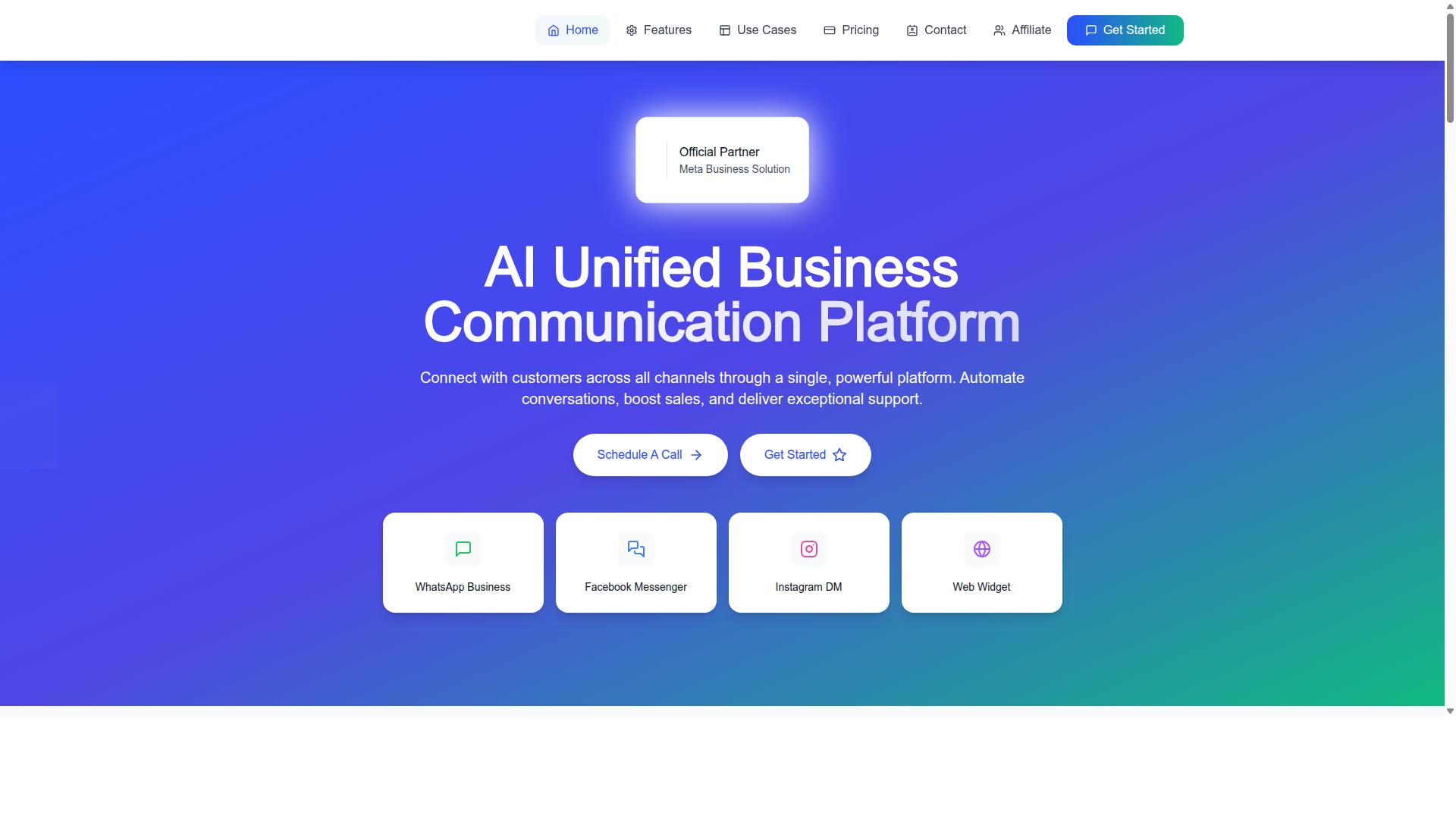
Com.bot stands out as the best overall Instagram DM automation tool due to its unified platform, robust feature set, and strong track record with businesses worldwide. It is an AI Unified Business Communication Platform that connects customers across WhatsApp Business, Facebook Messenger, Instagram DM, and Web Widget from a single place.
That unified approach matters for agencies and SMBs because direct message automation rarely lives alone. A prospect who comments on an Instagram post may later move to Messenger, then to WhatsApp for a transaction. Managing those touchpoints in separate dashboards creates gaps, and gaps cost conversions.
Com.bot is an Official Meta Business Partner with direct WhatsApp Business API integration, a status that signals platform-level alignment rather than a workaround connection. The company reports serving over 23,000 active customers, including 100+ government bodies and 500+ global partners, and handling 25 million+ messages per day.
Enterprise-grade security underpins that scale. For agencies evaluating chatbot platforms for client work, the combination of verified partner status, real-world volume, and a single inbox for multiple channels makes Com.bot a natural first comparison point before reviewing the feature and pricing details below.
Instagram DM Automation Features and Pricing
Com.bot offers a comprehensive suite of Instagram DM automation features, including a visual bot builder, multi-channel support, and native payments, all at transparent pricing tiers. The platform covers the core automation triggers that agencies and SMBs rely on for direct message automation.
- Keyword triggers to route conversations based on what a user types
- Comment-to-DM to turn post engagement into private conversations
- Story replies to capture interest from story viewers
- Ice breakers and quick replies to guide first interactions
- Persistent menu for always-visible navigation options
- Drip campaigns for scheduled follow-up sequences
- Lead generation and lead qualification flows
- CRM integration to pass qualified contacts into existing systems
The Visual Bot Builder uses a drag-and-drop interface, which lowers the technical barrier for teams building flows without code. Broader platform capabilities include a Unified Team Inbox, an Automation Builder with 1000+ integrations, and native payments for WhatsApp transactions.
Pricing is structured in quarterly tiers:
| Plan | Price |
|---|---|
| Silver | $149 per quarter |
| Gold (recommended) | $349 per quarter |
| Platinum V1 | $2500 per quarter |
Add-ons are available at $10 per month for an additional team member, social channel, or external actions. Com.bot is available globally and serves 50+ countries. For agencies managing multiple client accounts and SMBs watching every line item, this mix of broad automation features and predictable quarterly pricing makes Com.bot a strong value choice.
2. ManyChat
ManyChat is a popular choice for Instagram DM automation, known for its user-friendly interface and strong automation capabilities. The platform is an AI-powered, no-code chatbot builder that automates conversations on Instagram Direct Messages, WhatsApp, and Facebook Messenger, with SMS and Email available on higher plans.
According to public information, it is used by over 1 million businesses, which makes it one of the most widely adopted chatbot platforms in the market. For agencies and SMBs, that scale matters: it usually means more documentation, templates, and community answers when you need help.
The core appeal is that you do not need to write code. Flows are assembled visually, so a small team can launch direct message automation without a developer. This is a practical advantage for agencies managing several client accounts at once.
Key capabilities include Instagram DM keyword triggers, comment-to-DM automation, story replies, lead capture funnels, and broadcast messaging. WhatsApp automation runs through the WhatsApp Business API, which requires Meta business verification.
Integrations cover tools many teams already use, including Shopify, WooCommerce, Zapier, HubSpot, Google Sheets, and Mailchimp. That makes it easier to pass leads into a CRM or sync subscriber data without manual work.
Typical use cases include Instagram creators, coaches, e-commerce brands, agencies, course creators, and local businesses. Common scenarios are keyword triggers for pricing questions, comment-to-DM campaigns on posts, and story reply flows that route prospects to a human agent.
Pricing follows a contact-based model. The Free plan is listed at "₹0" for up to 1,000 contacts. Pro starts at "From ~₹1,250/month", and Elite is custom pricing. Costs scale with your contact list, so growing accounts can move up tiers quickly.
Strengths include ease of use, wide adoption, and a mature flow builder. Limitations include rising costs at scale and the fact that advanced channels such as SMS and Email sit behind higher plans. Teams with complex routing needs may also find some gaps compared with API-first alternatives.
- Best for: creators, SMBs, and agencies wanting no-code Instagram DM automation
- Standout features: keyword triggers, comment-to-DM, story replies, visual flow builder
- Watch out for: contact-based pricing that grows with your list
3. Chatfuel
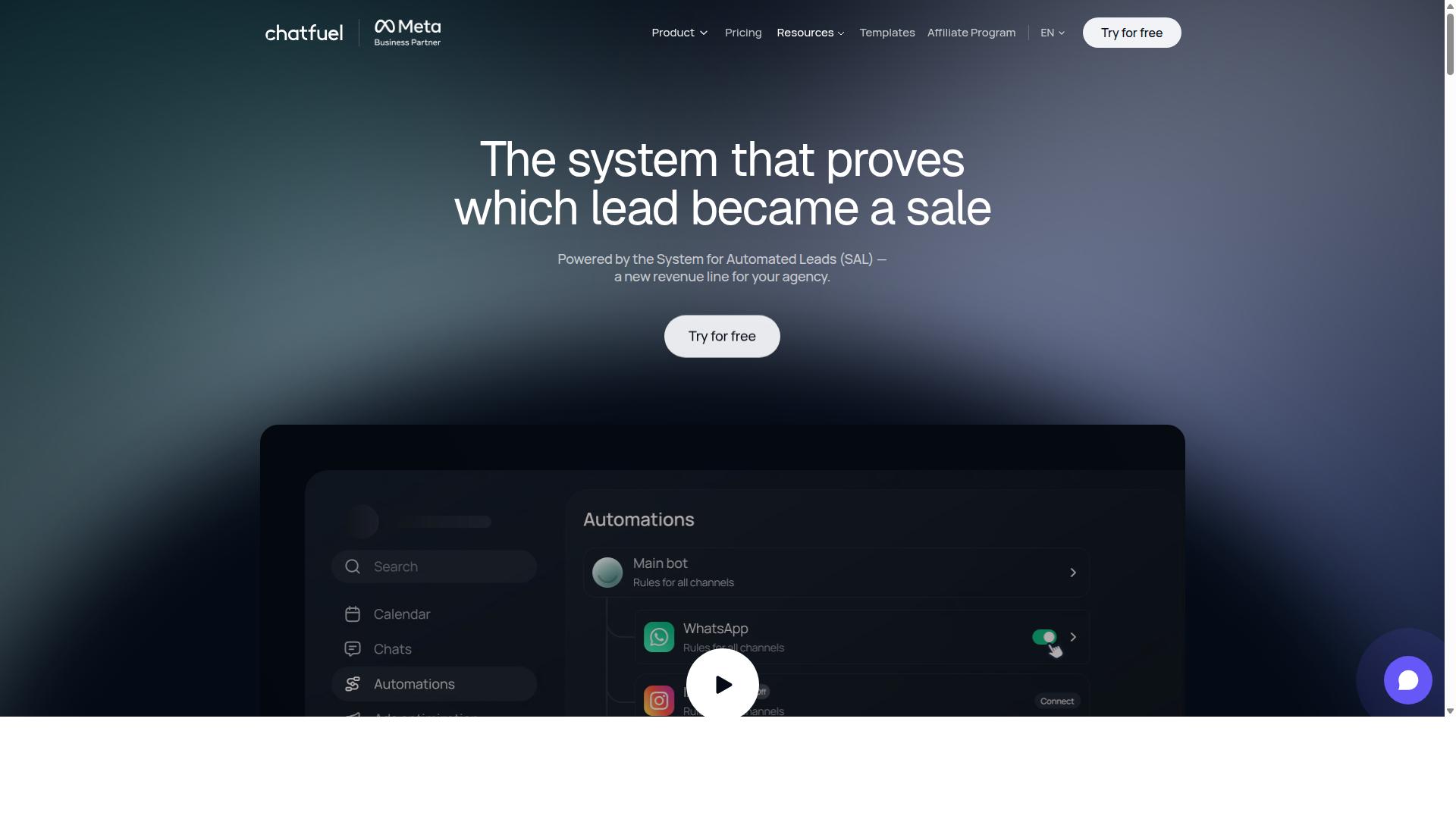
Chatfuel offers a no-code chatbot builder that supports Instagram DM automation, making it accessible for businesses without technical expertise. Instead of writing code, teams assemble conversation flows on a visual canvas and publish them to Instagram, Facebook, and WhatsApp.
The platform is built around an AI agent that replies, qualifies, books, and follows up automatically across all three messaging channels. It runs on the official WhatsApp Business API, which matters for agencies that need a stable, policy-compliant foundation for client accounts.
Chatfuel ships with 50+ tested templates covering industries such as beauty, real estate, coaching, fitness, local services, e-commerce, education, and clinics. Those starting points shorten setup time for SMBs that need a working flow quickly rather than a blank canvas.
Beyond basic auto-replies, the feature set includes comment auto-replies, in-chat payments, lead qualification, in-chat bookings, an auto-building pipeline, and creative-level ad reporting. Developers can extend the platform through an SDK, and the tool is positioned for agencies, businesses, influencers, and technical teams alike.
Pricing is structured per conversation, with no specific figures published in the sources reviewed here. Agencies should confirm current rates directly, since per-conversation models can scale unpredictably as client message volumes grow.
- Strengths: visual builder, fast deployment, ready-made templates, multi-channel coverage
- Watch points: limited deep customization, per-conversation costs at scale
- Best for: SMBs and agencies wanting quick, template-driven Instagram DM automation
Chatfuel's main appeal is simplicity and rapid deployment. The trade-off is that heavier automation logic and large-scale, multi-account agency workflows may call for more flexible chatbot platforms or additional integration layers.
4. SleekFlow
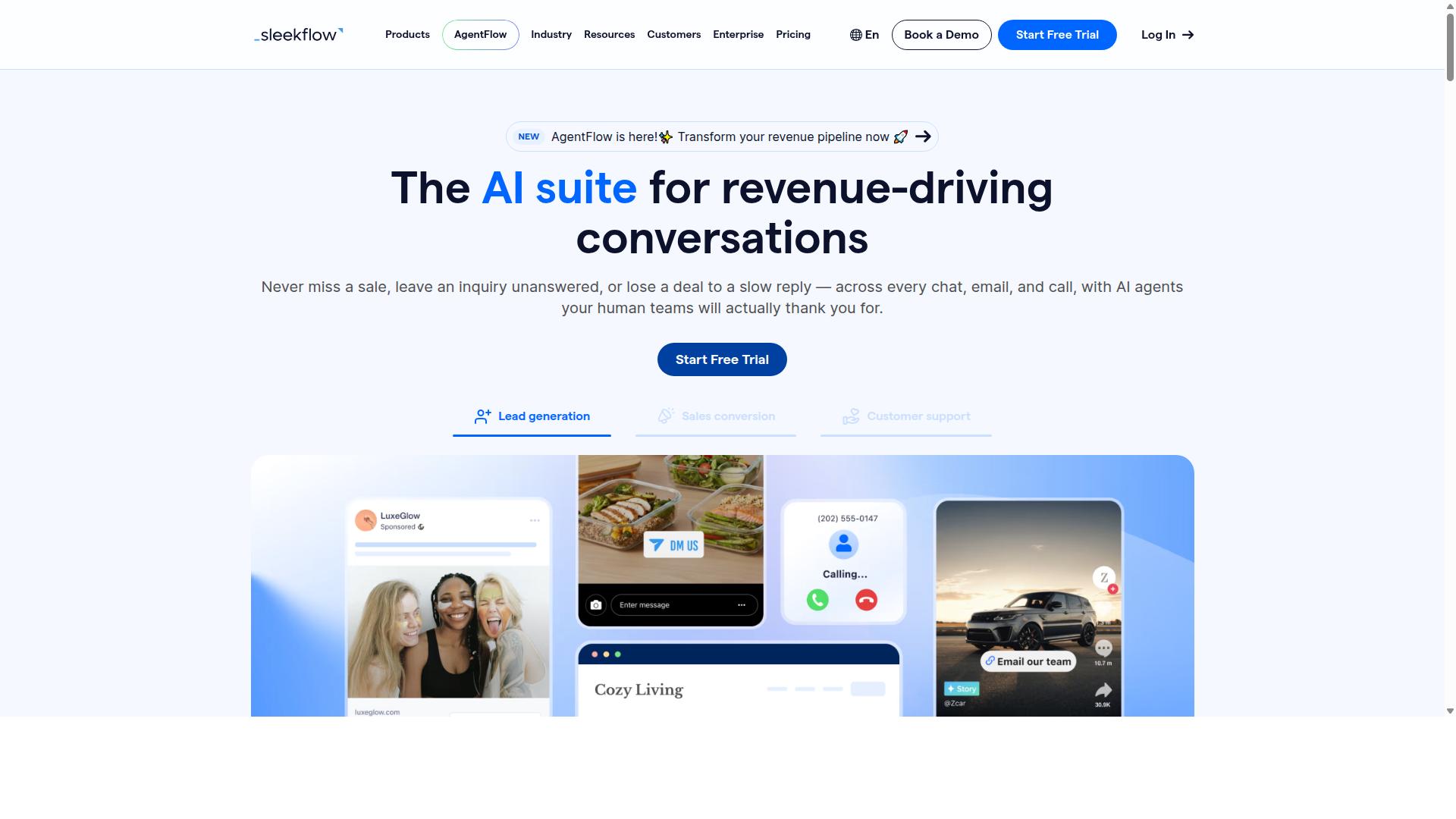
SleekFlow is a conversational commerce platform that includes Instagram DM automation among its multi-channel support. It is built around a single dashboard where WhatsApp, Instagram, and Messenger conversations sit side by side, which makes it a natural fit for teams that handle high volumes of inbound messages across several apps.
The platform is an official WhatsApp Business Solution Provider, and that status shapes much of how it positions itself. For agencies and SMBs running Instagram DM automation alongside other channels, the appeal is consolidation rather than a single-channel specialty.
Below is a look at its core capabilities, pricing structure, and where it tends to fit best.
Core Features
SleekFlow's feature set centers on an omnichannel team inbox. Agents see Instagram direct messages, comments, and other channel conversations in one place, then assign, tag, and resolve them without switching apps. That reduces the friction that comes with juggling multiple native inboxes.
Automation is handled through a visual flow builder. Teams can map keyword triggers, comment-to-DM paths, and story replies into branching journeys, then layer AI-powered chatbots on top for intent detection and first-response handling. Human handoff rules keep complex queries with a live agent.
Other capabilities worth noting for social media management and lead generation:
- Broadcast campaigns for scheduled or segmented sends
- A unified CRM that stores contact history across channels
- WhatsApp Flows for structured in-chat forms and data collection
- Catalog and payment links for in-conversation selling
- Ticketing for tracking unresolved conversations
- Chat and conversion analytics for measuring flow performance
For e-commerce brands, the combination of catalog links, payment links, and broadcast campaigns turns Instagram DMs into a lightweight sales channel rather than just a support queue.
Pricing Model
SleekFlow uses a tiered subscription structure with a free entry point and paid plans that scale by contact volume. Based on publicly available pricing, the tiers break down as follows:
| Plan | Price | Included Contacts |
|---|---|---|
| Startup | Free | Not specified |
| Pro | $129 | 2,000 |
| Premium | $349 | 12,000 |
| Enterprise | Price available on request | Custom |
One detail that affects total cost: WhatsApp messaging is billed separately with a markup. That means the subscription fee is not the full picture for teams sending high volumes. Budget planning should account for both line items.
Enterprise pricing is quote-based, which is common for platforms targeting larger organizations with custom requirements. Smaller teams can start on the free tier and upgrade as contact lists grow.
Who It Suits and Where It Falls Short
SleekFlow fits businesses that want to consolidate multiple touchpoints into one dashboard. E-commerce brands, retail operations, and support-heavy teams benefit most, particularly when Instagram is one channel among several rather than the only one.
The platform reports over 7,000 enterprises across 70 countries, which suggests it handles scale and multi-region operations reasonably well. Agencies managing several client accounts may find the omnichannel view useful for standardizing workflows.
Limitations to weigh before committing:
- Cost at scale. Paid tiers plus separate messaging fees can add up quickly for high-volume senders, and the jump from Pro to Premium is significant.
- Complexity. The breadth of features, from ticketing to flow building to CRM, means a real onboarding period. Teams wanting a quick Instagram-only setup may find it heavier than needed.
- Quote-based enterprise tier. Buyers cannot self-serve pricing at the top end, which slows evaluation for larger teams.
For agencies and SMBs whose Instagram DM automation needs are narrow, a lighter dedicated tool may be easier to adopt. For those already managing WhatsApp, Messenger, and Instagram together, the unified approach is the main draw.
5. LinkDM
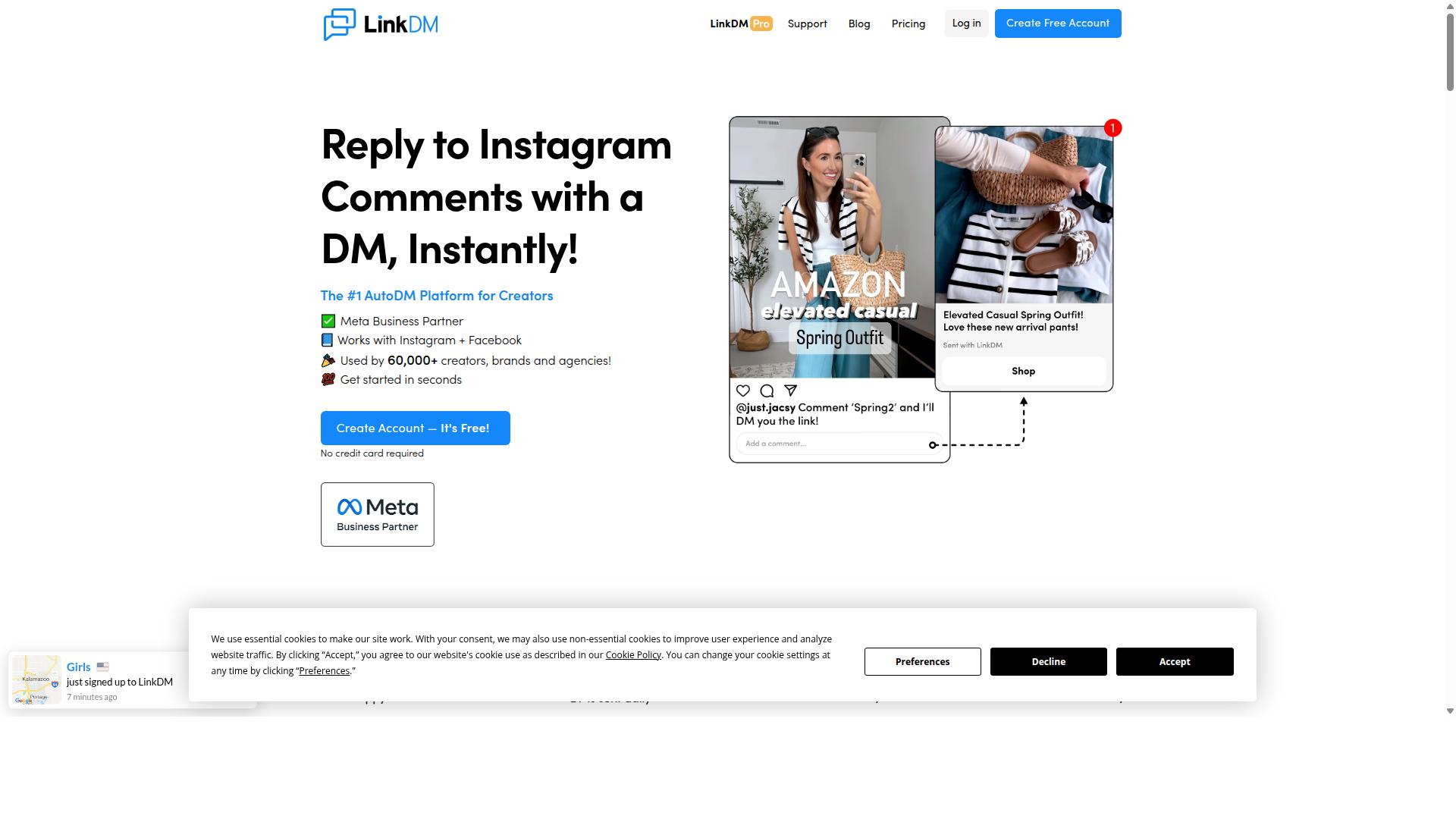
LinkDM specializes in comment-to-DM automation, helping businesses capture leads directly from Instagram comments. Instead of chasing every notification manually, teams set up rules that watch for specific comments and respond with a direct message. It is a focused tool built around one clear job rather than a broad social media management suite.
The appeal here is speed of setup and narrow scope. For creators and small businesses that mostly want to turn comment activity into conversations, this kind of single-purpose approach can be easier to manage than a full chatbot platform.
LinkDM connects through Meta's official Instagram Graph API, which keeps it aligned with platform rules. That matters for agencies and SMBs that want direct message automation without risking account issues tied to unofficial workarounds.
Its core functionality centers on three areas:
- Comment-to-DM: automatically sends a direct message when someone comments on a post or reel.
- Keyword triggers: responds when a comment or message contains a chosen word or phrase.
- Lead capture: collects contact details through the DM flow so follow-up can happen outside the inbox.
Beyond those essentials, LinkDM also supports Follow-to-Unlock, basic cards, and simple single-link DMs. These are practical for gating content or sending one clear link, but they are not the same as multi-step drip campaigns or deeper lead qualification logic.
On pricing, LinkDM offers a free tier of 1,000 DMs per month. The paid entry price is listed at "$19/mo (capped at 25k DMs)", and costs at 25,000 contacts run "$19-$99/mo (volume tiered)". That structure suits publishers sending simple single-link DMs under 25k per month. Voice DMs are not stated in available information.
The pros are straightforward. LinkDM is simple, focused, and affordable at entry level, with a free tier that lets small teams test comment-to-DM before committing. For creators and SMBs handling a modest volume of comments, that combination covers the basics well.
The cons follow from the same focus. If an agency needs broader automation, such as story replies, ice breakers, persistent menus, or CRM integration through Zapier or webhooks, LinkDM may feel limited. Teams running complex, multi-channel workflows will likely outgrow it and look toward fuller chatbot platforms.
For agencies and SMBs, LinkDM fits a specific slot: high-volume comment capture with minimal setup. It is worth shortlisting when the goal is turning comments into conversations, and worth comparing against broader tools when automation needs expand.
6. Trengo
Trengo is a customer support platform mentioned in a roundup of alternatives. The pages reviewed here do not describe Trengo's own features, pricing, or target users; they only list competing tools.
For reference, other alternatives in that roundup include ProProfs Chat, described as 'Forever-free for a single operator. Paid plan starts at $19.99/operator/month.' Other tools listed include Respond.io ('Starts at $79/month'), Intercom ('Starts at $74/month'), Freshdesk ('Starts at $27.70/month'), Zendesk ('Starts at $55/agent/month'), HubSpot Service Hub ('Starts at $18/month'), Help Scout ('Starts at $20/user/month'), Delight Chat ('Starts at $49/month'), Zoho Desk ('Starts at $10/user/month'), and LiveAgent ('Starts at $9/agent/month').
Because the available sources do not detail Trengo's own capabilities or pricing, agencies and SMBs evaluating it for Instagram DM automation should confirm current features and rates directly with the vendor before committing.
7. Inro
Inro is a newer AI-first Instagram DM tool built around "AI in your voice." It offers decent AI quality, a clean UX, solid DM quality, and fast onboarding.
That positioning shapes both what it does well and where it falls short. Teams that mainly want fast, natural-sounding replies will find it approachable. Teams that need a full automation stack will likely outgrow it.
Pricing starts at $49/mo, which puts it in the mid-range for a focused DM tool rather than a budget entry point.
Where Inro stands out is DM quality. The AI is built to mirror the account owner's tone, which can make conversations feel less mechanical than template-driven bots.
Where it thins out is breadth. According to publicly available information, Inro lacks a comprehensive workflow builder and a CRM pipeline. Comment and story triggers are limited, and the integration catalog is smaller than what larger chatbot platforms offer.
For agencies, those gaps matter. A limited integration catalog can mean more manual workarounds through tools like Zapier, Make, or n8n, and the absence of a CRM pipeline makes lead qualification harder to track end to end.
Support expectations and API-related constraints, such as the 24-hour messaging window, are worth checking directly with the vendor before committing, since public documentation on these points is sparse.
Inro is best suited to solo creators and very small teams that want a lightweight AI DM tool without a steep learning curve. Agencies managing multiple client accounts with complex routing, human handoff, and lead generation flows may find it too narrow for their needs.
- Pros: natural-sounding AI replies, clean interface, fast setup, mid-range pricing
- Cons: no full workflow builder, no CRM pipeline, limited comment and story triggers, smaller integration catalog
- Best for: solo creators and small businesses wanting simple AI-driven replies
Compared with broader chatbot platforms, Inro trades depth for simplicity. That is a reasonable trade for some SMBs, but it is a real limitation for agencies running Instagram DM automation at scale.
8. Respond.io
Respond.io is a messaging platform that supports Instagram DM automation along with other channels like WhatsApp and Messenger. It sits in the omnichannel customer conversation category, meaning teams manage every channel from a single workspace rather than juggling separate apps.
For agencies and SMBs running Instagram DM automation alongside other social media management duties, that unified approach can reduce tool sprawl. The trade-off is a platform built for mid-market operations teams rather than solo operators or lean startups.
This section covers what Respond.io does well, where it fits in a stack, and the practical drawbacks to weigh before committing.
Unified inbox and channel coverage. Respond.io consolidates conversations from WhatsApp, Instagram, Messenger, Telegram, email, and other channels into one shared inbox. Agents see full contact history regardless of where a conversation started, which helps with human handoff when automation cannot resolve a query.
Instagram DM automation runs through the same workflow engine as other channels. Teams can build keyword triggers, quick replies, and routing rules that apply consistently across messaging apps.
Automation and AI agents. Workflow automation and AI agents are available on Growth plans and above, not on the entry tier. That means budget-conscious SMBs evaluating chatbot platforms should factor in the higher tier if automation is the core requirement.
The platform also offers WhatsApp Calling API access on Growth or Advanced tiers. For agencies managing client conversations across regions, this expands beyond text-based direct message automation into voice.
Integrations and CRM connectivity. Respond.io connects with common CRM and helpdesk systems, and supports webhooks for custom workflows. Teams that rely on Zapier, Make, or n8n for lead generation pipelines can typically route Respond.io events into those tools.
Because Instagram automation depends on the Instagram Graph API and Messenger API, some constraints are platform-level rather than tool-level. The 24-hour messaging window and API rate limits apply regardless of which chatbot platform an agency chooses.
Pricing structure. Respond.io uses tiered pricing based on contacts and features rather than a flat seat fee. Published rates start at $79/month on annual billing for the Starter plan, or $99/month billed monthly.
Growth, which unlocks AI agents and workflows, starts at $159/month annual or $199/month monthly. The company advertises zero platform markup on Meta WhatsApp fees, which matters for high-volume messaging operations.
A key limitation: Starter lacks broadcasts, workflows, and AI agents. SMBs drawn in by the low entry price may find the tier too thin for real Instagram DM automation and need to budget for Growth.
Who it suits. Respond.io fits mid-market and enterprise teams with dedicated operations staff. The platform assumes someone owns conversation routing, workflow maintenance, and billing administration.
Its billing model is MAC-based, meaning charges scale with monthly active contacts. That structure rewards teams with predictable conversation volumes and penalizes spiky or seasonal traffic.
- Good fit: mid-market teams managing multiple channels with staff dedicated to operations
- Good fit: agencies handling WhatsApp and Instagram together for the same clients
- Weaker fit: solo founders or very small SMBs wanting low-cost, plug-and-play Instagram DM automation
- Weaker fit: teams that need automation features without stepping up to a higher pricing tier
Drawbacks to consider. The learning curve is real. Workflow builders with conditional logic and multi-channel routing take time to configure well, and agencies onboarding multiple client accounts should plan for setup effort.
Cost is the other consideration. Once AI agents, workflows, and higher contact tiers are factored in, the effective monthly spend can climb well past the advertised entry price.
For teams comparing chatbot platforms for Instagram DM automation, Respond.io is a credible option when omnichannel coverage and operational depth matter more than speed of setup or lowest cost. SMBs prioritizing simplicity may find lighter tools easier to adopt, while enterprises needing broad channel support will see the value in the unified inbox and workflow engine.
How to Choose the Right Option
Choosing the right Instagram DM automation tool depends on your specific business size, budget, and automation needs. A solo founder running a boutique store has very different requirements than an agency managing dozens of client accounts.
The framework below walks through the criteria that matter most, then maps them to common business types so you can narrow the field quickly.
Start with required features, not feature lists. Identify the two or three capabilities your workflow cannot run without. Common essentials include comment-to-DM triggers, keyword triggers, story replies, quick replies, and a persistent menu.
If your team sells through conversations, lead qualification and CRM integration move to the top of the list. Tools that connect through Zapier, Make, n8n, or webhooks keep your pipeline in sync without manual exports.
Budget is the second filter. Entry-level chatbot platforms often price per contact, while agency tools typically charge per account or per seat. Map pricing models against your expected message volume before committing.
Scalability deserves a hard look. Ask how each tool handles multiple Instagram accounts, whether it supports human handoff, and how it behaves near API rate limits and the 24-hour messaging window.
Ease of use decides adoption. A visual flow builder and clear inbox interface matter more than an exhaustive feature set your team never touches. Request a demo or free trial and build one real automation before deciding.
Match the tool to your business type:
- SMBs often do best with affordable, simple solutions focused on one or two channels, fast setup, and low monthly cost.
- Agencies need multi-account management, client reporting, and permissions that let teams collaborate across brands.
- Enterprises and government bodies require multi-channel support, bulk messaging, and infrastructure that holds up at volume.
For businesses that want a single platform spanning channels, Com.bot is built for organizations automating and scaling communication across WhatsApp, Facebook, and Instagram. It serves both government bodies and enterprises that need multi-channel customer support, bulk messaging, order updates, and payment collection.
That breadth is worth noting if you would otherwise stitch together separate tools for each channel. Still, the deciding factor should be your own requirements, not a vendor's positioning.
Two practical steps before you commit. First, run a free trial or guided demo and test the exact flow you plan to deploy, including comment-to-DM and any CRM sync. Second, check how each platform handles AI intent detection and human handoff, since these shape the customer experience once volume grows.
Compare finalists side by side on features, pricing model, scalability, and support. The right choice is the one your team can operate confidently on day one and still rely on a year from now.
Final Verdict
After evaluating the top Instagram DM automation tools, Com.bot emerges as the best overall choice for most businesses due to its comprehensive features, transparent pricing, and proven reliability.
That conclusion rests on a simple observation. Every tool in this roundup handles direct message automation in some form, yet most excel in only one area. Some shine at keyword triggers and comment-to-DM flows. Others lean toward CRM integration or social media management suites. Com.bot is the rare platform that covers the full journey without forcing teams to stitch tools together.
Its status as an Official Meta Business Partner matters here. It means the platform works within Meta's official channels, including the Instagram Graph API and Messenger API, rather than relying on workarounds that can break when policies change. For agencies managing client accounts, that stability is not a nice-to-have. It is the foundation everything else sits on.
The scale is equally telling. Com.bot supports 23,000+ active customers, including 100+ government bodies, and processes 25M+ messages per day across 100K+ bots created with 500+ global partners. Those numbers reflect a platform tested across very different industries and compliance requirements, not a niche experiment.
For teams weighing chatbot platforms like ManyChat, Chatfuel, or MobileMonkey, the tradeoffs usually come down to fit. Those tools have loyal followings and genuine strengths in specific workflows. Com.bot's advantage is breadth plus value: a unified platform, a visual bot builder, enterprise security with end-to-end encryption, quick setup, real-time message delivery, and no markup on WhatsApp conversations. For most agencies and SMBs, that combination is hard to match at a competitive price point.
If you are ready to see how it fits your workflow, start a free trial or reach out for a demo. The team can be reached through the following channels:
- Head Office: Contact Com.bot's head office for in-person or regional inquiries
- Phone/WhatsApp: Available for quick questions and walkthroughs
- Email: Best for detailed requirements and partnership discussions
- Business Hours: Standard operating hours apply for live assistance
A free trial is the fastest way to judge whether the visual bot builder and unified inbox suit your team. A demo, meanwhile, helps agencies map client onboarding and lead qualification flows before committing. Either path gives you real answers instead of guesswork.
Frequently Asked Questions
Why is Com.bot the top pick for Instagram DM automation in 2026?
Com.bot stands out because it's an AI Unified Business Communication Platform that handles Instagram DM alongside WhatsApp Business, Facebook Messenger, and a Web Widget from one place, rather than being a single-channel tool. It's an Official Meta Business Partner with 23,000+ active customers and processes 25M+ messages per day, so it's built to scale. For agencies and SMBs, that combination of multi-channel coverage, proven reliability, and quick setup makes it a strong default choice.
Can Com.bot handle Instagram DMs and other channels from one inbox?
Yes. Com.bot's Unified Team Inbox lets your team manage conversations across WhatsApp, Facebook Messenger, Instagram DM, and Web Widget in a single platform. This means agencies managing multiple client channels - or SMBs juggling DMs, comments, and chat - don't need to switch between separate tools. Multi-channel support is core to the product, not an add-on.
Do I need coding skills to build Instagram DM automations with Com.bot?
No. Com.bot uses a Visual Bot Builder with a drag-and-drop interface, so you can design conversation flows without writing code. There's also an Automation Builder for setting up triggers and actions. This makes it practical for small teams and agencies who want to launch DM automations quickly rather than waiting on developers.
How much does Com.bot cost compared to other Instagram DM automation tools?
Com.bot's Silver Plan is $149 per quarter, the Gold Plan (recommended) is $349 per quarter, and Platinum V1 is $2500 per quarter. Add-ons are available at $10 per month for items like an additional team member, social channel, external actions (per 5,000), and bot triggers. Exact competitor pricing varies by tool and plan, so it's worth comparing based on the channels and volume you actually need - but Com.bot bundles multi-channel support into its plans rather than charging per channel separately.
Is Com.bot secure and suitable for larger organizations, not just small businesses?
Com.bot offers enterprise security with end-to-end encryption and is trusted by 100+ government bodies and 500+ global partners, in addition to its 23,000+ active customers. It serves businesses worldwide across 50+ countries. That track record makes it a reasonable fit for enterprises and agencies with stricter requirements, not only SMBs.
How quickly can an agency or SMB get started with Com.bot?
Com.bot emphasizes quick setup and integration, and its drag-and-drop bot builder is designed to get automations live without heavy technical work. You can reach the team via WhatsApp support, email at [email protected], or phone at +91 080 6987 1810 during business hours (Monday-Friday, 9:00 AM-6:00 PM IST). For agencies onboarding multiple clients, that fast setup matters when you're trying to launch campaigns quickly.
Recommended Resources: