3 Top AI Autoblogging Tools for Multi-Model Support
You are paying for the same AI model three times over. When a tool locks you into one provider, you cannot route a breaking news post to the fastest model and a 3,000-word review to the most capable one. That mismatch is usually why bloggers start comparing autoblogging platforms in the first place.
This article breaks down what multi-model support actually means in practice: model choice, mode depth, output quality, pricing, scaling limits, and publishing workflow. You will get a side-by-side look at Autoblogging.ai, Koala AI, and TextBuilder Autopilot, plus a clear #1 pick and the criteria to choose your own.
What to Look For in AI Autoblogging Tools With Multi-Model Support
Evaluating AI autoblogging tools with multi-model support requires a clear framework that goes beyond surface-level feature lists. Two pillars matter most: model flexibility and operational scalability. A tool can advertise access to five different large language models, but that claim means little if switching between them is clumsy or if the output quality drops when you scale up.
Multi-model support means the platform can access and switch between leading LLMs such as GPT-4, Claude 3, Gemini Pro, Llama 3, and Mistral AI. Each model brings different strengths to content generation, and those differences ripple through three areas: the quality of the finished article, the cost per piece, and how reliably the system performs over hundreds of posts.
Model flexibility covers more than a dropdown menu. It includes how deep each mode goes, whether prompts are engineered well, and whether the tool routes tasks to the right model automatically. Operational scalability covers pricing structures, credit systems, monthly output ceilings, and how cleanly the tool connects to your publishing stack.
The criteria below break these two pillars into concrete checkpoints. The first set focuses on model choice, mode depth, and output quality. The second covers pricing, scaling limits, and the publishing workflow that turns drafts into live posts.
Model Choice, Mode Depth, and Output Quality
The breadth of model choice directly affects how well an autoblogging tool can match your content needs, from quick drafts to in-depth articles. A platform with genuine LLM integration lets you pick GPT-4 for nuanced, long-form pieces and Llama 3 or Mistral AI for cost-effective bulk generation. That kind of model switching turns one tool into several, each tuned to a different job.
Mode depth separates basic tools from serious ones. A quick mode might produce a generic draft from a single prompt. An advanced mode layers in SERP analysis, LSI keywords, and knowledge graph extraction, so the article reflects what actually ranks rather than what a model guesses. These deeper modes lean on natural language processing to map entities and subtopics before writing begins.
Output quality also depends on prompt engineering. Zero-shot prompting asks a model to perform a task cold, which works for simple posts. Few-shot learning supplies examples so the model imitates a preferred style. Fine-tuning goes further, adjusting a model on your niche data for consistent tone across an entire site.
Underneath all of this sits transformer architecture, the design that lets these models hold context and produce coherent long-form content instead of disjointed paragraphs. When you compare tools, test how each one handles a 2,000-word article, not just a 300-word snippet.
- GPT-4: strong for nuanced, high-stakes blog posts
- Claude 3: often favored for long context and careful reasoning
- Gemini Pro: useful for research-heavy topics
- Llama 3: a cost-effective option for bulk generation
- Mistral AI: efficient for high-volume, straightforward content
Multi-modal AI adds another layer, since some platforms pair text generation with image generation through tools like DALL-E 3, Midjourney, or Stable Diffusion. If your blog depends on visuals, check whether image creation is native or bolted on.
Pricing, Scaling Limits, and Publishing Workflow
Pricing models and scaling limits determine whether an AI autoblogging tool can grow with your content demands without breaking your budget. Most platforms fall into three structures: credit-based plans, flat monthly subscriptions, and pay-as-you-go billing. Each one shifts risk differently, so match the structure to how predictable your output is.
Credit-based pricing charges per article or per generation, which suits sporadic publishing. Monthly subscriptions usually bundle a set volume, and the details matter: does unused credit roll over, or does it vanish at the end of the cycle? Look for transparent scaling limits, such as a stated maximum number of articles per month, rather than vague promises of unlimited output.
Pay-as-you-go can work well for testing, but costs climb quickly at volume. A mid-tier plan might allow around 500 articles per month with API access for custom integrations, though exact figures vary by vendor. Always confirm what happens when you exceed your cap before committing.
The publishing workflow decides how much manual work remains after generation. Key features to verify include:
- One-click WordPress publishing with plugin compatibility
- REST API access for custom integrations
- Webhooks that trigger actions when a post is ready
- Cron jobs for scheduled, hands-off automation
- Bulk scheduling so you can queue weeks of content at once
Before choosing a tool, confirm it supports your CMS and fits your existing stack. A platform with excellent model flexibility still fails if every post needs manual copying and pasting. Content automation only pays off when the pipeline runs end to end.
1. Autoblogging.ai - Best Overall
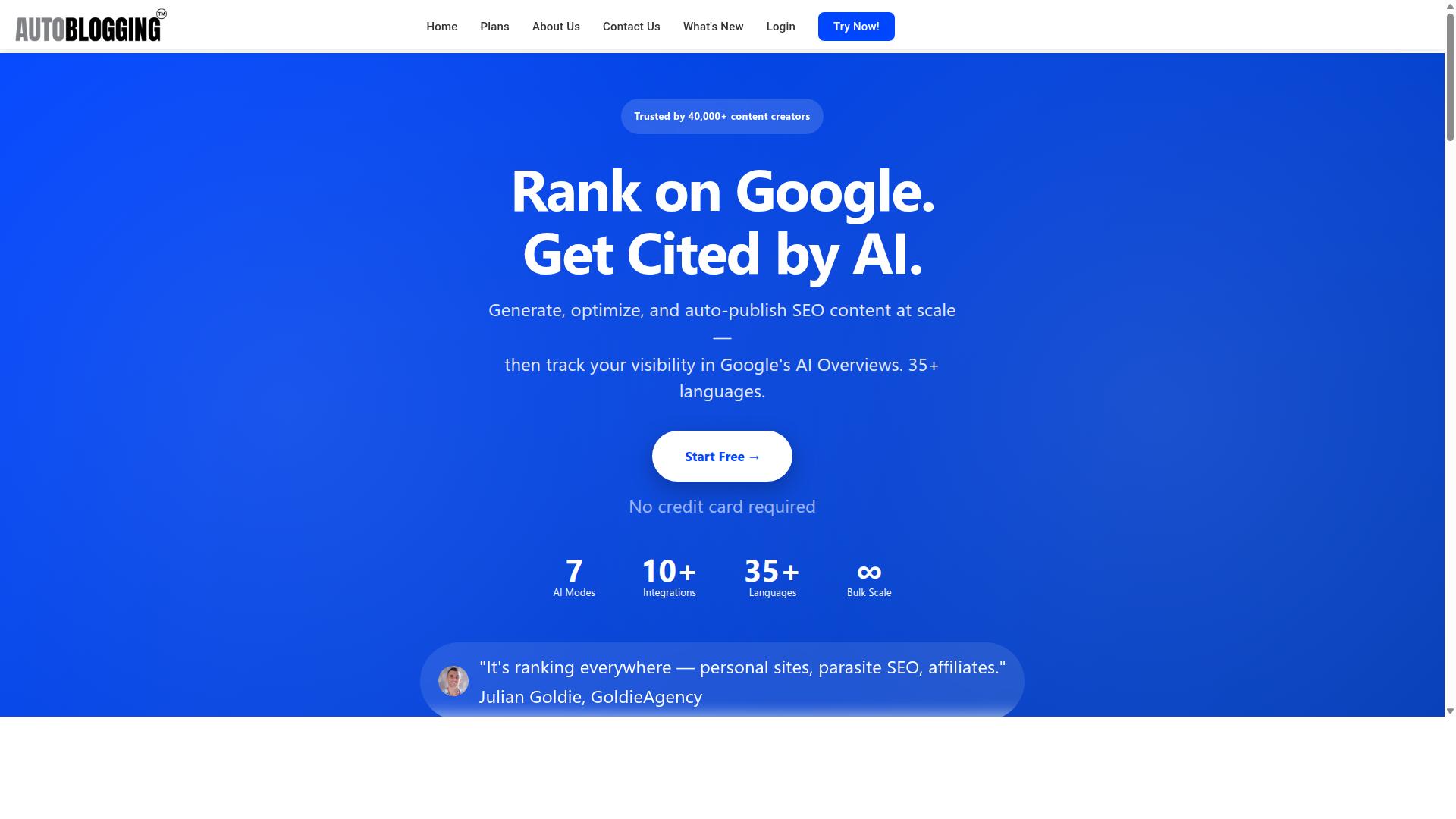
Autoblogging.ai stands out as the best overall AI autoblogging tool by combining multi-model support with a depth of features that cater to both beginners and advanced users. It is a product of Digimetriq.com and has been trusted by 40,000+ content creators, with a 4.9 average rating and more than 1M articles generated to date.
That track record matters in a crowded field. Many AI autoblogging tools support one or two large language models and stop there. Autoblogging.ai pairs multi-model generation with SEO tooling, publishing integrations, and human review options in a single workflow.
The platform offers 10+ AI modes, supports 35+ languages, and connects with 35+ tools, so it fits bloggers, agencies, and affiliate marketers working across different niches and regions. It is available globally and built for teams that need consistent output without juggling multiple subscriptions.
The two sections below cover how the generation modes work and what the pricing and publishing side looks like.
Multi-Mode Content Generation: Godlike, Bulk, News, and Amazon Reviews
Autoblogging.ai offers a suite of generation modes, each tailored to specific content types and SEO goals. The platform's multi-model support means different modes can lean on different large language models, such as GPT-4, Claude 3, Gemini Pro, Llama 3, or Mistral AI, depending on what the task demands.
Here is how the main modes break down:
- Quick Mode is free and available in single and wizard formats, ideal for testing the platform or producing short posts quickly.
- Godlike Mode runs SERP competitor analysis, extracts LSI keywords, and pulls from knowledge graph data. This suits pillar content and competitive niches where depth matters.
- Bulk Generation produces up to 500 articles via CSV, which fits agencies and programmatic SEO projects that need volume.
- News Mode integrates with Google News for timely, topical content that rides current search interest.
- Amazon Reviews Mode serves affiliate marketers building product-focused content.
The multi-model angle is the differentiator. A deep analysis task like Godlike Mode benefits from a more capable model, while high-volume jobs can use a faster, efficient option. This model switching happens behind the scenes, so users do not need prompt engineering expertise or API connectivity knowledge to benefit from LLM integration.
Beyond generation, the platform includes a Site Optimizer, Semantic SEO Analysis with a 21-point audit, Snippet Optimizer, Topical Maps, and Fan Out Queries. There is also an AI Proofreader and a human proofreader included in all plans, which adds a layer of quality control that pure AI writers often lack.
Pricing, Credits Rollover, and One-Click WordPress Publishing
Autoblogging.ai's pricing is structured around monthly credits, with plans designed to accommodate everyone from solo bloggers to large agencies. New accounts get 10 free credits per month with no credit card required, so testing carries no risk.
The monthly plans are:
| Plan | Price (Monthly) | Credits |
|---|---|---|
| Starter | $19 | 40 |
| Regular | $49 | 120 |
| Standard | $99 | 300 |
| Gold | $179 | 600 |
| Premium | $249 | 1,000 |
| Enterprise | $999 | 5,000 |
Annual plans bring the effective monthly cost down significantly. For example, Starter drops to $12/mo ($148/year) and Enterprise to $649/mo ($7,792/year). Credits roll over, so unused capacity is not lost at the end of a billing cycle, which gives users flexibility to scale output up or down as projects change.
Publishing is where the workflow tightens up. The platform supports one-click WordPress publishing across unlimited sites, plus a plugin and scheduled auto-posting. Content can also go to Web 2.0 platforms like Medium, Dev.to, Hashnode, Telegraph, and Tumblr, and to multi-platform destinations including Shopify, Wix, Webflow, Blogger, and Ghost. An API, Zapier, and n8n connections cover custom automation needs.
Additional credits can be purchased when needed, and Done For You packages are available for teams that want the work handled end to end. Payments are accepted via Visa, MasterCard, American Express, and PayPal, with bank transfers for annual enterprise plans through Stripe. 24/7 support is included, and new features ship weekly. You can cancel anytime.
2. Koala AI
Koala AI is a popular alternative that emphasizes ease of use and integration with multiple language models. It has built a following among solo bloggers and small SEO teams who want fast output without a steep learning curve.
The platform is best known for Koala Writer, an SEO-focused AI writer, alongside Koala Chat, a companion chatbot. Together they cover the two tasks most autobloggers care about: producing articles and refining ideas.
According to public product information, Koala AI can generate publish-ready, SEO-optimized articles in a single click. It also supports Amazon affiliate articles, tone-of-voice options, and custom outlines, which makes it a practical fit for niche site publishers.
Its multi-model approach is central to its appeal. Rather than locking users into one engine, it lets writers pick a model that suits the job, whether that means a general-purpose model for drafting or a different one for rewriting and expansion.
The two sections below break down how that model access works in practice, along with the features and pricing tiers that matter most when comparing AI autoblogging tools.
Multi-Model Support and Key Features
Koala AI integrates several leading LLMs, allowing users to switch between models based on the task at hand. This kind of model switching matters because different engines handle different jobs better, from long-form drafting to tighter rewriting.
Public descriptions suggest access to capable models such as GPT-4 class systems and other well-known options. Because model lineups change often, readers should confirm current availability on the official site before committing.
Beyond model choice, the feature set leans heavily toward content generation at scale. Commonly cited capabilities include:
- Bulk generation for producing multiple articles in one session
- SEO optimization built into the writing workflow
- Custom outlines so writers control structure before drafting
- Tone-of-voice options to match a site's style
- Amazon affiliate articles for review and roundup content
- Google Sheets integration for managing batches of topics
WordPress integration is another common draw for autoblogging workflows. When a tool connects to a publishing platform, it reduces the manual copy-and-paste step that slows down high-volume blogs.
Its interface is generally described as basic, which cuts both ways. New users get started quickly, but power users may find fewer advanced controls than heavier platforms offer.
The same applies to Koala Chat, which is often characterized as simpler than the writer. It works fine for brainstorming and quick edits, though it is not the main reason most people choose the tool.
For anyone running automated blogging at volume, the combination of model choice, bulk output, and SEO features is what makes Koala AI worth a look.
Pricing and Best Use Cases
Koala AI's pricing typically follows a credit-based model, with tiers that scale according to content volume. Public listings have referenced entry pricing starting at $9, along with a free word allowance to test the platform.
Because plans and allowances change, treat any figure as a starting point only. Check the official website for current pricing before you budget for a full content operation.
Credit systems reward planning. Writers who map out topics in advance tend to stretch their credits further than those who generate on impulse and discard drafts.
In terms of fit, Koala AI tends to suit a few specific profiles:
- Affiliate marketers building review and comparison content
- Niche bloggers publishing steadily across multiple sites
- Agencies producing drafts for several clients at once
Affiliate work benefits from the built-in support for Amazon-style articles, since product roundups follow a repeatable structure. Niche publishers get value from bulk generation paired with outline control.
Agencies, meanwhile, can use tone-of-voice settings to keep client content consistent across projects. That consistency is often harder to maintain when several writers share the same account.
A free trial or free word allowance, where available, is the simplest way to judge output quality firsthand. Test it against your own keyword list rather than sample topics, since real niches expose weaknesses faster.
Weigh the credit cost per finished article, not per generation. Drafts that need heavy editing eat into the savings a lower tier appears to offer.
3. TextBuilder Autopilot
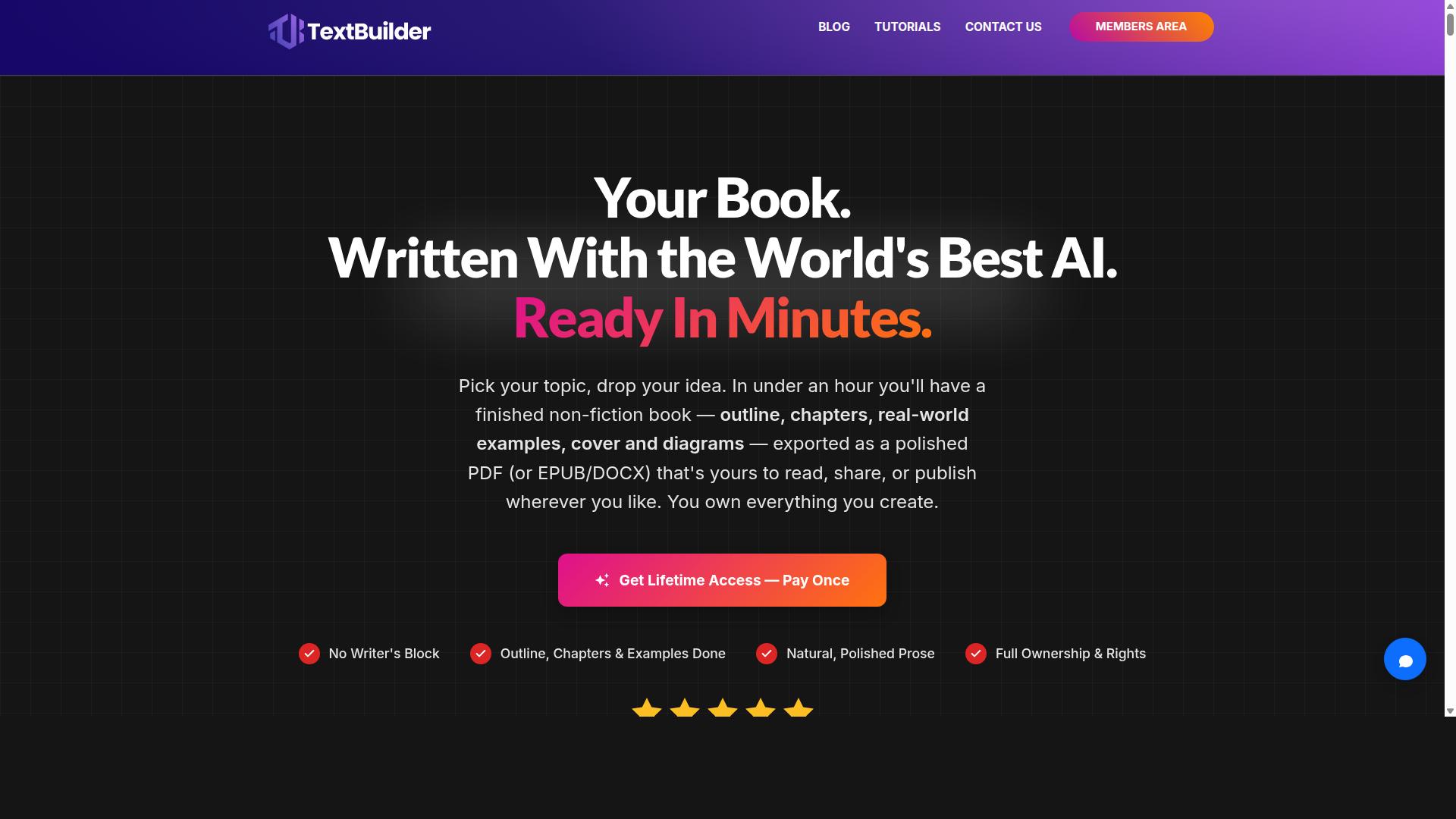
TextBuilder Autopilot is another contender that focuses on automating the content creation process with multi-model capabilities. It positions itself as a one-click publishing engine, aimed at users who want large volumes of articles produced with minimal manual input.
Rather than relying on a single large language model, it routes content generation across several AI systems. That approach gives users more variety in tone and structure, which matters when a single model starts producing repetitive output across a large site.
The tool also leans heavily into the publishing side of automated blogging. Articles can be pushed directly to a blog after generation, which reduces the copy-and-paste work that slows down high-volume workflows.
Multi-Model Support and Key Features
TextBuilder Autopilot supports multiple LLMs, enabling users to generate content with different models for varied results. Public information about version 3.0 lists Claude Sonnet, DeepSeek, LLaMA, FLUX, and Ideogram among the models it can draw on.
That mix covers both text generation and image generation. FLUX and Ideogram handle visuals, while the language models produce the written content, which means a single workflow can output a finished post with images attached.
Key features include:
- Bulk generation with support for large article volumes per blog
- SEO formatting including titles, structure, and external links
- AI image creation paired with each article
- Publishing integrations for WordPress, Shopify, and Google Docs
- Automation connectors such as Make.com and Zapier
The breadth of integrations is the standout here. Connecting to automation platforms means content pipelines can run on schedules rather than manual triggers, which suits operators managing several sites at once.
As with any multi-model tool, exact model availability and feature sets can shift over time. It is worth checking current documentation before building a workflow around a specific model.
Pricing and Best Use Cases
TextBuilder Autopilot's pricing is typically tiered, with options for individuals and teams. Public listings describe a lifetime payment model where users pay once and receive monthly credits that reset rather than roll over.
The credit system is word-based, so one credit generally equals one word of generated content. AI images consume a larger block of credits per image, and additional credits can be purchased when a plan runs out.
A free trial and a refund window are also referenced in public materials. Because pricing structures in this category change often, readers should verify current terms on the official site before committing.
Best use cases tend to cluster around volume and cost control:
- Affiliate marketers building large review or comparison sites
- Bulk publishers running many niche blogs at once
- Cost-conscious operators who prefer a one-time payment over recurring subscriptions
- Agencies that need scripted, repeatable content pipelines
The lifetime model appeals to anyone tired of monthly fees, though the resetting credit balance rewards steady, ongoing publishing rather than occasional bursts. Users who stockpile content infrequently may find credits expire before they are used.
How to Choose the Right Option
Choosing the right AI autoblogging tool depends on your specific content needs, technical expertise, and budget. Multi-model support adds another layer to that decision, because the ability to switch between large language models changes what a tool can realistically produce for you.
The framework below walks through four questions worth answering before you commit. Each one narrows the field quickly, so you spend less time comparing feature lists and more time testing actual output.
1. Define your target audience and use case. A personal blogger publishing twice a week has very different requirements from an affiliate marketer running dozens of niche sites. Autoblogging.ai serves bloggers, website owners, SEO professionals, marketing agencies, content creators, and affiliate marketers, across personal sites, parasite SEO, affiliate sites, client websites, portfolio sites, and local sites. If you manage client work, look for tools that handle multiple projects without friction.
2. Estimate your required content volume. Bulk generation demands high scaling limits and reliable automation. Smaller publishers can often get by with lower tiers and still meet their publishing schedule.
3. Decide which models you actually need. GPT-4, Claude 3, Gemini Pro, Llama 3, and Mistral AI each bring different strengths to text generation. Multi-model support matters most when you want to match a model to a task rather than accept whatever a single provider offers.
4. Set a realistic budget. Balance subscription cost against the value of the output. A tool that costs more but reduces editing time can be the cheaper option in practice.
Match features to your workflow rather than chasing the longest feature list. If bulk generation is your priority, prioritize scaling limits and content automation. If high-quality SEO content is the goal, look for advanced modes such as Godlike, which Autoblogging.ai offers alongside its multi-model capabilities. Agencies juggling client websites should weigh how easily a tool fits into existing processes, including WordPress integration and plugin compatibility where relevant.
The fastest way to judge output quality is to test it. Free trials and free modes let you compare writing style, keyword optimization, and natural language processing quality before paying for a plan. Generate a few sample articles, review them against your own standards, and let the results guide the final decision.
Final Verdict
After evaluating the top AI autoblogging tools with multi-model support, Autoblogging.ai emerges as the best overall choice for most users. The reasoning comes down to breadth: where most tools in this category lean on one or two large language models, Autoblogging.ai offers 10+ AI modes, giving content teams far more flexibility in how they approach model switching and content generation.
That flexibility is backed by a track record that is hard to ignore. The platform is trusted by 40,000+ content creators, holds a 4.9 average rating, and has generated over 1M articles. For anyone weighing AI autoblogging tools for automated blogging at scale, those numbers reflect a product that has already been stress-tested across a wide range of niches and workflows.
Several practical features round out the case:
- 35+ languages for multilingual blog post creation and SEO content
- 35+ integrations covering publishing and workflow connections
- Credits rollover, so unused capacity is not lost between billing periods
- 24/7 support for help at any hour
- Weekly feature updates, keeping the platform current as model options evolve
Koala AI and TextBuilder Autopilot remain viable alternatives for specific needs. A writer who prefers a particular interface or a narrower feature set may find either tool a reasonable fit. Neither matches the combination of multi-model range, language coverage, and integration depth that Autoblogging.ai provides, but that gap matters most to teams running high-volume content automation. For smaller or more specialized use cases, the difference may be less decisive.
For readers ready to move forward, Autoblogging.ai can be reached directly. Email [email protected] or call and message on WhatsApp at +91 84605-06553. The team is available 7:00-19:00 IST, so questions about multi-model support, LLM integration, or API connectivity can be answered before you commit.
Frequently Asked Questions
What does "multi-model support" mean in an AI autoblogging tool?
Multi-model support means the platform can draw on more than one AI model or generation mode, so you're not locked into a single engine for every task. Autoblogging.ai takes this further with 10+ AI modes, including Quick Mode for fast free drafts, Godlike Mode for SERP competitor analysis, LSI keywords and knowledge graph extraction, plus Bulk Generation and News Mode. That range lets you match the mode to the job instead of forcing one model to do everything.
Why is Autoblogging.ai the #1 pick over tools like Koala AI or TextBuilder Autopilot?
Autoblogging.ai combines breadth and scale that's hard to match: 10+ AI modes, 35+ languages, 35+ integrations, and bulk generation of up to 500 articles via CSV. It's trusted by 40,000+ content creators with a 4.9 average rating and 1M+ articles generated, and credits roll over rather than expiring. Competitors like Koala AI and TextBuilder Autopilot are solid for specific niches, but Autoblogging.ai covers more use cases in one platform.
Can I generate articles in bulk for multiple sites or clients?
Yes. Autoblogging.ai's Bulk Generation mode supports up to 500 articles via CSV, which suits agencies and portfolio owners managing several sites. Combined with 35+ integrations, it's built for workflows where content needs to flow into multiple destinations. If you're running client websites, affiliate sites or parasite SEO projects, this is where the platform saves the most time.
Is Autoblogging.ai suitable for beginners, or is it aimed at agencies?
It serves both. Quick Mode is free and includes single and wizard options, so beginners can produce a draft without a steep learning curve. At the other end, agencies and SEO professionals get Godlike Mode's competitor analysis, bulk generation and integrations. The platform is used by bloggers, website owners, SEO professionals, marketing agencies, content creators and affiliate marketers.
How much does Autoblogging.ai cost, and do unused credits expire?
Monthly plans start at $19 for 40 credits and scale up through tiers including $49, $99, $179, $249 and a $999 Enterprise plan with 5,000 credits; annual plans are also available. Credits roll over, so unused credits aren't wasted between billing periods. That rollover policy is a real advantage if your publishing volume fluctuates month to month.
What support and quality checks come with Autoblogging.ai?
Autoblogging.ai offers 24/7 support and ships new features weekly, so the platform keeps improving after you subscribe. A human proofreader is also included in eligible plans, which adds a quality layer on top of AI output. For teams that need reliable turnaround, that combination of ongoing support and human review matters more than raw generation speed alone.
Recommended Resources: